

| Temporary Refuge Impairment Analysis (TRIA) scope defines what the study will assess, which hazards it will cover, what information is needed, and what results it must provide. A clear scope sets the refuge boundary, major accident scenarios, impairment criteria, required endurance, method, and deliverables. These choices help the study answer the right safety questions and provide useful evidence for risk decisions and the offshore safety case. |
A weak TRIA scope can lead to missing data, late changes, and a report that does not answer the safety-case question.
A good scope helps prevent this. Here are seven practical steps to get it right.
What does a TRIA study do?
A Temporary Refuge (TR) is intended to provide shelter for a specified period during defined emergency scenarios. It may not be suitable for every accident scenario.
A TRIA evaluates how selected major accident scenarios could affect refuge protection and whether agreed impairment criteria could be reached during the required endurance period. Depending on the study objective and method, the results may include an estimated time to impairment. That estimate is specific to the scenarios, refuge, protective systems, data, and criteria assessed.
For example, the study may examine smoke or gas entering through doors, leaks, or the HVAC system. It may also consider whether internal conditions remain within agreed criteria when ventilation is isolated.
Fire, heat and explosion loads can also affect the refuge. Their effects on walls, doors, and other protective features may be assessed in linked fire, explosion, or structural studies. The TRIA scope should identify which results it relies on, who is responsible for those studies, and how their outputs will be used.
In this guide, Temporary Refuge Integrity (TRI) means the wider question of whether the refuge and its supporting systems can protect occupants for the required period. TRIA can contribute evidence to that assessment; it does not replace the broader integrity case. Confirm terminology and required evidence against the operator’s performance standards and the rules that apply to the facility.
The study should also link with Fire and Explosion Risk Analysis (FERA), Quantitative Risk Assessment (QRA), where used, and Evacuation, Escape and Rescue Analysis (EERA).
Which facilities and projects typically need a TRIA?
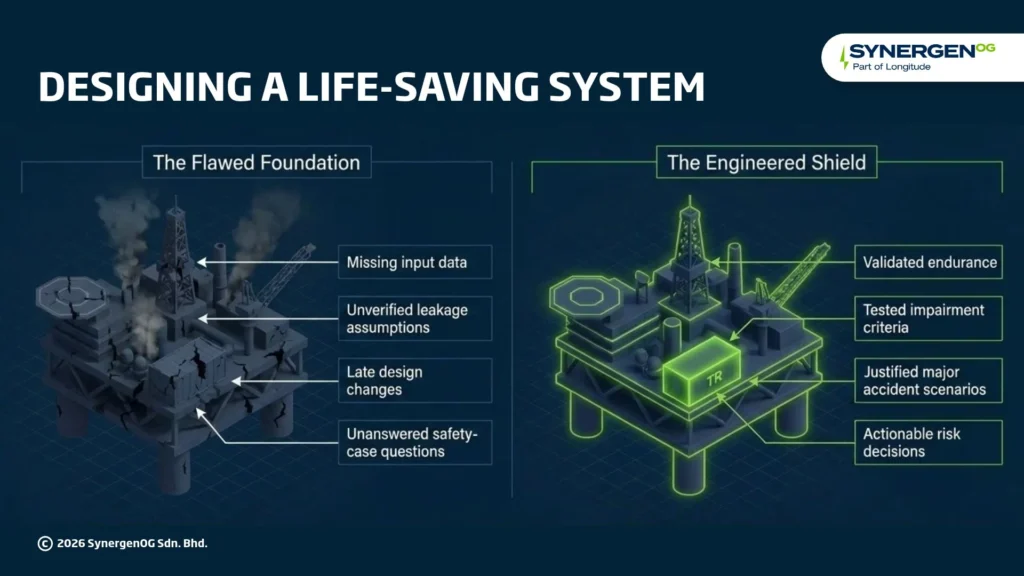
TRIA is most relevant where an offshore facility relies on a designated temporary refuge or other credited protected space to shelter personnel during a major accident. Typical applications include:
- Fixed offshore oil and gas installations: Manned production and processing platforms, central processing complexes, and wellhead platforms with a protected refuge or control/muster area.
- Floating production and storage assets: FPSOs, floating production units, FLNG facilities and occupied storage/offloading units where a refuge is part of the emergency-response strategy.
- Mobile offshore drilling units: Jack-up rigs, semi-submersibles and drillships where personnel depend on a defined refuge or protected accommodation/control space. Assess these against unit-specific rules; ISO 13702:2024 excludes mobile offshore units, although its principles can be used as guidance.
- Offshore accommodation and support installations: Manned accommodation or support facilities exposed to credible hydrocarbon hazards where the emergency plan credits an enclosed refuge.
For normally unmanned installations with no occupied refuge, a standalone TRIA may not be appropriate. Onshore control rooms and occupied buildings near hazardous facilities may instead call for an occupied-building risk, shelter-in-place or building-siting assessment; apply TRIA terminology only where the project defines a temporary-refuge assessment.
When should a project commission or revisit TRIA?
- New developments: During concept selection, FEED or detailed design, and before start-up where refuge performance must be demonstrated for the safety case or design basis.
- Conversions and major upgrades: For example, FPSO/FLNG conversions, redeployments, tie-backs, additional processing modules, sour-service changes or life-extension projects that alter credible accident scenarios.
- Brownfield modifications: When changes to inventories, layout, HVAC intakes or isolation, fire and gas systems, doors or refuge boundaries could affect impairment or endurance.
- Operational and assurance triggers: When occupancy, muster/evacuation assumptions, leakage-test results, integrity inspections, incidents or periodic safety-case reviews call the existing basis into question.
A standalone TRIA is not automatically prescribed for every example above. The dutyholder should establish whether new analysis, a focused update or documented confirmation of an existing assessment is proportionate to the hazards, applicable rules and refuge performance standards.
7-Step Guide to Scope a TRIA Study
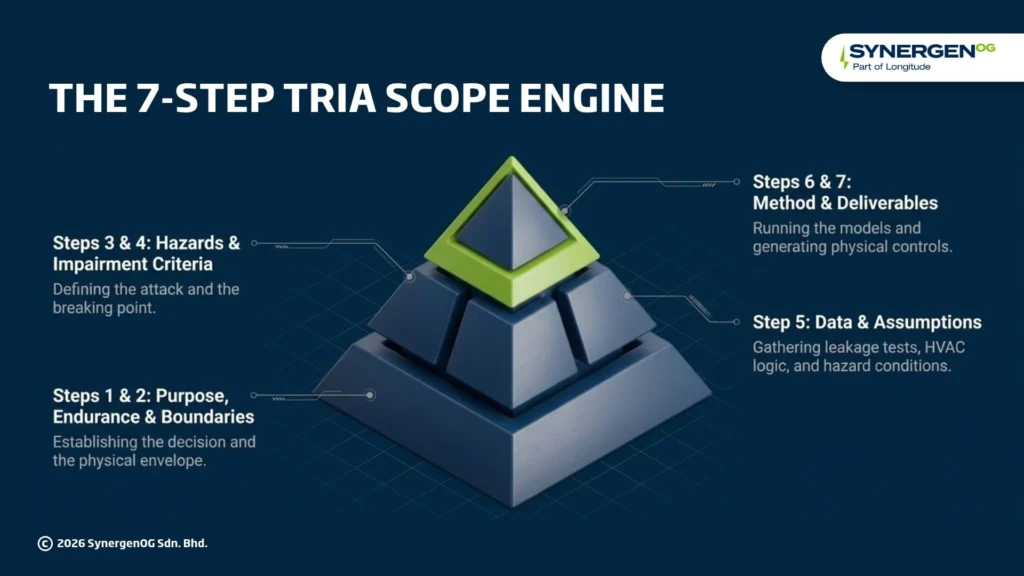
Step 1: State the purpose and the decision
Start with a simple question: What decision must this study support?
- A new offshore facility or floating-unit conversion needs refuge-performance evidence for its safety case or design basis.
- A platform has changed its process, layout, occupancy, or refuge.
- A review has identified gaps in TR protection.
- A leakage test, inspection, or incident has raised a concern.
Then define the required refuge endurance. This is the period for which people must remain protected under the emergency-response plan. It should allow for the planned response, including muster, incident control, evacuation, or recovery where relevant. Do not assume it is always the same as the quickest evacuation time.
Example study objective: Assess whether the temporary refuge can maintain the required protection for the specified endurance period under the selected major accident scenarios, and identify any gaps.
Agree who will use the results and what decision they need to make. This keeps the study focused.
Step 2: Draw clear boundaries
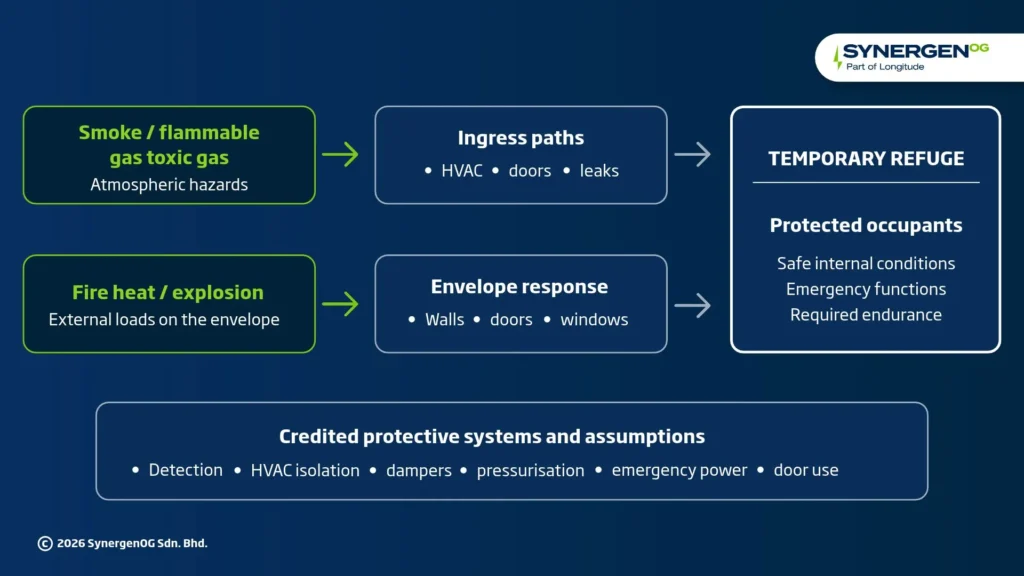
Mark exactly what the study includes. Start with the actual protected refuge boundary, not just the room used for muster.
- The refuge rooms, capacity, access points, and adjoining spaces.
- Doors, windows, penetrations, and known leakage paths.
- HVAC intakes, dampers, isolation logic, and pressurisation.
- Gas and fire detection, shutdown, and emergency power where they protect the TR.
- Normal, shutdown, and emergency operating conditions.
- Personnel movement and door opening during muster.
Also state whether other muster or congregation areas are included. Explain what the EERA covers, what the FERA or structural assessment covers, and what is excluded from TRIA.
Include the applicable design basis, TR performance standards, and local regulatory requirements. NOPSEMA and UK HSE guidance may be useful references, but the applicable rules depend on where the facility operates. ISO standards also have defined scopes and may not apply in full to every type of offshore unit.
Step 3: Select the hazards and scenarios
A TRIA does not need to model every possible event. It needs a justified set of credible major accident scenarios that could challenge the refuge.
Start with the Major Accident Hazard (MAH) register and relevant HAZID, FERA, dispersion, QRA, and EERA work. Check that the selected scenarios cover the important ways in which the refuge or its protective systems could be impaired.
| Hazard or effect | What the scope should check |
| Smoke and combustion gases | Smoke exposure outside the TR, ingress routes, and conditions inside. |
| Flammable gas | Gas ingress, build-up, and the potential for a hazardous atmosphere. |
| Toxic gas, including H₂S where relevant | Gas concentration and exposure over time against agreed criteria. |
| Loss of safe internal air, where relevant | Oxygen availability, CO₂ build-up, and other effects during HVAC isolation. |
| Fire heat and explosion | Effects on the refuge envelope and protective features, using linked studies as needed. |
| Protective-system failure | Credible loss, delay, or damage to detection, HVAC isolation, dampers, or power. |
Ask for a scenario register. For each case, it should show the hazard, source study, reason for selection, and any important exclusion.
Practical tip: If the facility handles sour gas, check H₂S early. If it does not, do not include H₂S simply because it appears in a generic checklist.
Step 4: Agree the impairment criteria first
Impairment criteria define when refuge conditions no longer meet the required level of protection. Set them before the modelling starts.
Depending on the hazards, criteria may cover toxic gas exposure, smoke effects, flammable gas levels, oxygen depletion, carbon dioxide build-up, or occupant heat stress. Include each criterion only where it is relevant to the facility and selected scenarios.
Thermal criteria should use a justified method for assessing heat stress or occupant response. State the exposure duration and relevant assumptions, such as occupancy and environmental conditions.
The criteria should also reflect people’s ability to carry out essential emergency tasks. A refuge must support safe decisions, communication, and the planned response, not only keep people alive.
- Agree the criteria and where each one comes from.
- Confirm the required refuge endurance and occupancy basis.
- Identify any separate structural, fire, or blast performance limits that apply.
- Record who approves the criteria and any changes.
There is no single set of numerical limits suitable for every facility. Use the approved project basis, relevant standards, and applicable regulatory expectations.
Step 5: List the inputs you must supply
A TRIA is only as reliable as the information used. Your scope should say what information is needed, who owns it, and when it will be available.
- TR drawings, room volumes, doors, openings, and equipment layout.
- Operating cases, occupancy numbers, and required endurance.
- MAH scenarios, inventories, and time-dependent release or hazard conditions.
- FERA, gas-dispersion, smoke, thermal, and blast-study outputs, as applicable.
- HVAC design, detection and shutdown logic, damper closure times, and emergency power.
- Refuge leakage or pressure-test data and related inspection findings.
- TR performance standards, operating procedures, and EERA assumptions.
Read: How to Prove Personnel Can Reach Safety – Scope of EERA
Leakage data need careful interpretation. A pressure test helps describe how leaky a refuge is, but it does not directly predict how much smoke or gas will enter during an accident. Wind, pressure differences, HVAC status, and doors opening during muster may change the result. The study should combine relevant leakage data with the pressure conditions, system states, openings, and a suitable ingress method.
If important information is missing, start a data-gap register. Record the assumed value, the reason for using it, its possible effect on the results, and the person who must confirm it.
Step 6: Choose the method and level of detail
The scope should explain the proposed method in plain terms. A typical sequence is:
- Confirm the refuge boundary, required endurance, and impairment criteria.
- Select and document the credible scenarios.
- Define the hazard conditions outside the refuge and how they change over time.
- Identify entry routes and the protection provided by doors, HVAC, dampers, and other systems.
- Calculate or model how internal conditions change during each scenario.
- Compare results with the criteria and report whether they are reached during the required period. Estimate time to impairment where the method supports it.
- Check important uncertainties, including credible safeguard delays or failures.
- Identify performance gaps and practical ways to reduce risk.
The method should match the problem. A simple calculation may be enough where the hazard and assumptions are straightforward. Complex releases, uncertain leakage, tight endurance margins, or several connected spaces may need more detailed modelling.
Ask the study team to explain where specialist fire, explosion, structural, or heat assessments are needed and how their results will feed into TRIA. The scope should name the responsible study or team for each important input.
How should you read the results?
Compare the predicted conditions with the agreed impairment criteria for each relevant scenario and the required refuge endurance. Ask which hazard reaches a criterion first and which safeguards the assessment assumes will work.
If no criterion is reached during the assessed period, the report should say so. That does not mean the refuge has unlimited endurance. Results apply only to the scenarios, data, criteria, and assumptions assessed.
Example: Two platforms have similar refuges. One has worn doors, uncertain leakage, and slow damper closure. The other has recent test data and verified isolation performance. The first may need more sensitivity checks even if the rooms are the same size.
Step 7: Define the deliverables
Do not end the scope with “submit a TRIA report”. Say what the report and supporting records must contain.
- Study basis: Purpose, boundaries, endurance, criteria, and exclusions.
- Scenario register: Selected major accident cases and reasons.
- Input and data-gap register: Data used, quality issues, and owners.
- Method and calculations: Models, versions, assumptions, and limitations.
- Results: Conditions over time, criteria reached or not reached, and the controlling hazard.
- Time-to-impairment estimates, where supported by the method.
- Sensitivity review: Assumptions that could materially change the findings.
- Performance review: Safeguards credited, TR performance gaps, and key dependencies.
- Actions register: Recommended risk-reduction measures, priorities, and owners.
- Interface summary: Links to FERA, QRA, EERA, and relevant structural studies.
- Safety-case summary and review record: Main findings, decisions, and close-out.
The safety case should explain the study approach and key outcomes. It should not rely on attaching a technical report without showing what was learned and how the findings were used.
Ask for controls, not just numbers
A good TRIA connects each important finding to a practical improvement. Examples include sealing leakage paths, repairing doors, improving HVAC isolation, checking detection and shutdown logic, updating emergency procedures, or strengthening inspection and test requirements.
These findings help the operator evaluate what further risk reduction is reasonably practicable. A TRIA can provide technical evidence for an ALARP demonstration, but a table of actions does not, on its own, prove that risk is ALARP. The operator must assess the options and document the decision within the wider safety assessment.
Common TRIA scoping mistakes
- Leaving exclusions unwritten, so the study boundary is unclear.
- Agreeing impairment criteria only after the results are available.
- Using old leakage data without checking its condition or uncertainty.
- Assuming dampers close instantly or all protective systems will always work.
- Using a generic refuge duration that does not match the emergency plan.
- Leaving FERA, EERA, or structural-study interfaces unresolved.
- Failing to review the assessment after a change that could affect TR performance.
TRIA scope of work checklist
Use this quick check before issuing a request for proposal:
☐ Purpose and decision are stated.
☐ TR boundary, rooms, and interfaces are defined.
☐ Occupancy, operating modes, and required endurance are agreed.
☐ MAH scenarios and their sources are listed.
☐ Impairment criteria and approval basis are clear.
☐ Leakage, HVAC, and safety-system assumptions are identified.
☐ Inputs, owners, and data gaps are recorded.
☐ Method, sensitivity cases, and exclusions are defined.
☐ Links to FERA, QRA, EERA, and other studies are agreed.
☐ Results will be compared with the TR performance requirements.
☐ Deliverables, review steps, and action ownership are defined.
Final thoughts
A TRIA scope is more than paperwork. It decides whether the study asks the right questions and gives the team evidence it can use.
Get the purpose, boundaries, hazards, criteria, input data, method, and deliverables right at the start. The work becomes clearer, and the results are easier to use in the safety case and risk decisions.
SynergenOG specialises in process safety, technical risk and loss prevention. Being part of the wider Aqualis group as part of Longitude Engineering brings specialist risk assessment together with facilities and subsea engineering capability.Depending on the project scope, SynergenOG can act as an expert TRIA consultant throughout the assessment and close-out process: This integrated approach helps connect risk findings to engineering decisions across concept, FEED, detailed design, operations and late-life modifications. Contact SynergenOG to discuss an initial TRIA applicability review, a full study or an independent review of an existing assessment.
Technical references
- https://www.nopsema.gov.au/sites/default/files/documents/Supporting%20Safety%20Studies%20(A308937).pdf
- https://www.nopsema.gov.au/document-hub/guidance-notes
- https://www.hse.gov.uk/offshore/assets/docs/sheet32006.pdf
- https://www.hse.gov.uk/offshore/assets/docs/ed-temporary-refuge-integrity.pdf
- https://www.fabig.com/external-publications/hse-rr997/
- https://www.hse.gov.uk/research/rrhtm/rr997.htm
- https://www.iso.org/standard/82438.html
- https://www.iso.org/standard/82437.html
- https://www.hse.gov.uk/pubns/books/l65.htm
- https://www.hse.gov.uk/pubns/priced/l65.pdf
- https://www.hse.gov.uk/research/rrhtm/rr1179.htm
- https://www.hse.gov.uk/research/assets/docs/rr1179.pdf
- https://www.nopsema.gov.au/safety/safety-case
Technical Note: Regulatory requirements, terminology and acceptance criteria for Temporary Refuge studies vary by jurisdiction, flag state, coastal state, operator management system and project specification. This article gives general scoping guidance and does not set impairment limits or refuge endurance values, which depend on the scenarios, data, assumptions and criteria of each study. Check asset-specific decisions against the governing regulations, safety case, design basis, and company engineering standards.