
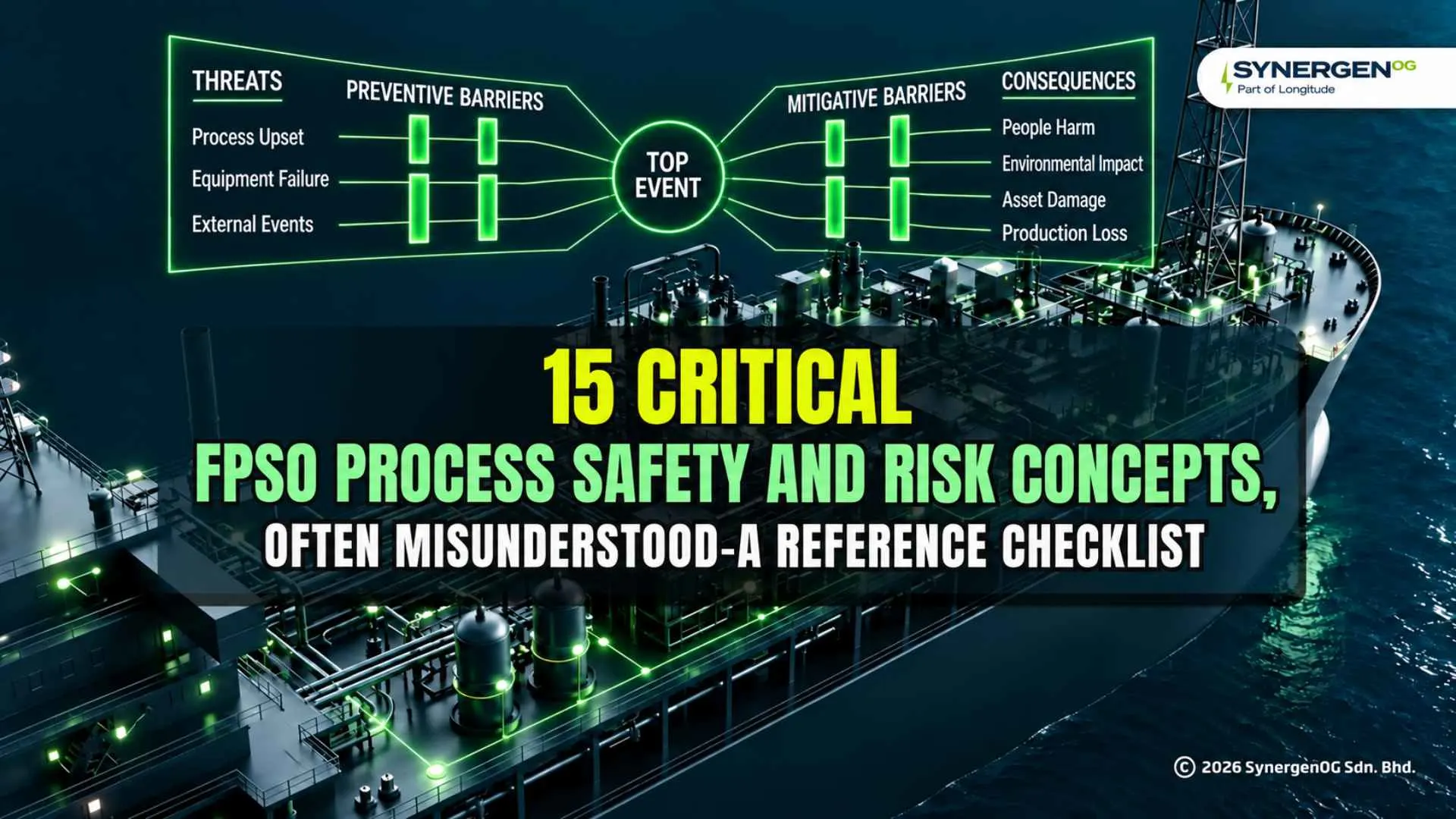
| FPSO process safety and risk concepts are most useful when they are tied to specific major-accident scenarios and measurable barrier performance. For hydrocarbon process hazards, loss of primary containment is a common top event, but FPSO risk also includes collision, loss of station keeping, stability, structural, and marine events. This guide explains 15 concepts teams often confuse and shows how to turn HAZID, ALARP, LOPA, SIL, MOC, RBI and barrier management into daily operating discipline. |
On 6 July 1988, the Piper Alpha production platform in the North Sea was destroyed by explosions and fire, killing 167 people. One critical sequence involved condensate pump A: a pressure safety valve associated with the pump had been removed for maintenance, and the open connection had been temporarily blanked. Failures in permit-to-work and shift-handover arrangements meant the incoming crew did not have the full equipment-status picture when the pump was returned to service.
Piper Alpha was a fixed platform, not an FPSO, but its lessons on control of work, communication, escalation and barrier performance remain directly relevant to offshore major-hazard management.
That distinction matters because the presence of equipment, procedures or studies do not demonstrate process safety. Protection has to be connected to a specific accident scenario, given a defined safety function and performance requirement, and then maintained and verified throughout the asset life cycle.
The same discipline applies to terminology. HAZID, HAZOP, ALARP, LOPA, SIL, QRA, MOC and RBI are related, but they are not interchangeable. Each answers a different question. When those questions are blurred, teams can mistake completion of a study or installation of a safeguard for proof that risk is adequately controlled.
Why FPSO Process Safety and Risk Concepts Need Scenario-Specific Thinking
An FPSO combines hydrocarbon processing, large liquid inventories, marine systems and occupied spaces on a single floating asset. The major-accident risk picture therefore extends beyond conventional topsides process hazards.
Depending on the asset, the safety case or equivalent major-hazard assessment may need to address loss of primary containment, fire and explosion, collision, loss of station keeping, mooring or turret failure, loss of stability, structural failure, riser or well events, cargo/offloading incidents and other marine hazards.
That combination creates several recurring risk drivers:
- Large hydrocarbon inventories. Processing and storage can place substantial flammable inventory on the same hull as utilities, control rooms and accommodation.
- Congestion and partial confinement. Equipment density can increase turbulence and flame acceleration. Explosion severity is influenced by gas-cloud size, congestion, confinement, ventilation, ignition location and layout.
- Escalation potential. A local release can become a major accident when isolation, depressurisation, fire protection, structural protection or emergency-response barriers fail or are impaired.
- Marine and stationkeeping hazards. Collision, mooring/turret issues, ballast and stability failures, hull integrity and offloading interfaces can create major-accident scenarios that are not simply variations of process loss of containment.
- Restricted escape, evacuation and rescue options. Personnel may depend on temporary refuge, protected escape routes, survival craft and external rescue arrangements under demanding weather and sea-state conditions.
- SIMOPS and changing operating states. Maintenance, lifting, marine operations, offloading, shutdown/start-up and temporary equipment can change both initiating-event likelihood and barrier availability.
For hydrocarbon-process bowties, loss of primary containment (LOPC) is a common top event. It should not, however, be described as the universal FPSO top event. Major-accident management starts by defining the relevant top events and consequences for the actual asset and then identifying the barriers needed to prevent, control or mitigate each scenario.
A Practical FPSO Barrier-Management Framework
For explanation, the safeguards in this article are grouped into six functional stages: prevent, detect, control and isolate, mitigate escalation, protect people, and evacuate/escape/rescue. This is a simplified teaching framework rather than a universal industry taxonomy. IOGP Report 544, for example, standardises process-safety barrier types and categories differently.
Formal barrier management should always follow the operator’s applicable framework, regulatory regime and scenario-specific performance standards.
1. Prevent the top event
Prevention aims to stop the defined top event from occurring. For hydrocarbon containment scenarios, this can include inherently safer design, pressure-containment integrity, corrosion and inspection programs, process control, relief protection, safety instrumented functions where they act preventively, operating limits and disciplined control of work.
Practical check: Verify that prevention barriers are defined against credible causes and that their performance requirements are measurable. A safeguard name on a bowtie is not enough.
2. Detect the hazardous condition
Detection provides timely information that a dangerous deviation or release has occurred. Depending on the scenario, this may include process alarms, pressure/level instrumentation, hydrocarbon gas detection, fire detection or leak-detection systems.
Practical check: Review detector coverage, voting logic, alarm management, impairment status and the actions expected after detection. Detection is only valuable when it initiates or enables an effective response.
3. Control, isolate and depressurise
Once a hazardous condition or release is detected, the objective is to stop additional inventory feeding the event and to reduce the energy available for escalation. ESD systems, shutdown valves, riser ESD valves, subsea isolation where provided, and blowdown/depressurisation systems may perform different parts of this function.
Practical check: Do not treat isolation and depressurisation as the same function. Isolation limits continued inflow; depressurisation reduces pressure and inventory. Both require scenario-specific response-time and performance criteria.
4. Mitigate fire, explosion and escalation
Mitigation limits consequence severity after prevention has failed. Typical measures include drainage, ventilation, ignition control, deluge and firewater, passive fire protection, blast/fire walls, structural protection and spacing/layout features.
Practical check: Test performance against the defined standard. For deluge, for example, blocked or misaligned nozzles matter when they reduce required coverage or application density; a visual check alone may not demonstrate performance.
5. Protect people and maintain a place of relative safety
Temporary refuge, protected escape routes, emergency lighting, communications, muster arrangements and emergency command systems help protect personnel while the installation responds to a developing event. A temporary refuge is designed for specified performance and endurance conditions; it should not be described as providing indefinite protection until an incident is resolved.
Practical check: Reassess escape-route availability and TR assumptions when maintenance, SIMOPS, temporary equipment or operating modes change the physical or hazard environment.
6. Escape, evacuate and rescue
If personnel cannot remain safely on the installation, the emergency-response philosophy must support escape, controlled evacuation and rescue/recovery. Depending on the installation and jurisdiction, this can include TEMPSC/lifeboats, liferafts, secondary means of escape, walk-to-work or marine transfer arrangements, and external rescue. Helicopters can be a preferred means of precautionary evacuation but may be unavailable during an acute fire, explosion or severe-weather event.
Practical check: Verify that EER arrangements are credible for the major-accident conditions and environmental envelope identified in the safety assessment, not only for calm-weather drills.
Having a Barrier Is Not the Same as Demonstrating Protection
A barrier should be defined by the safety function it performs and by the technical, operational and organisational elements required to realise that function. Depending on the barrier framework, formal performance standards may address functionality or effectiveness, capacity, availability and reliability, response time, integrity, survivability or robustness, independence and dependencies.
For day-to-day communication, “effective, available and capable” is useful shorthand: the barrier must achieve the intended function, be in service when demanded, and have sufficient capacity under the accident conditions. It should not replace the measurable criteria in the asset’s performance standards.
Piper Alpha shows why this distinction matters. The disaster involved a combination of technical, human and organisational failures: permit-to-work and shift-handover arrangements failed to communicate equipment status; firewater availability was compromised by operating arrangements during diving; escalation from interconnected hydrocarbon systems was not stopped quickly enough; and weaknesses in design and emergency response compounded the event.
The Cullen Inquiry that followed made 106 recommendations and reshaped UK offshore major-hazard regulation.
15 FPSO Process Safety and Risk Concepts: A Reference Checklist
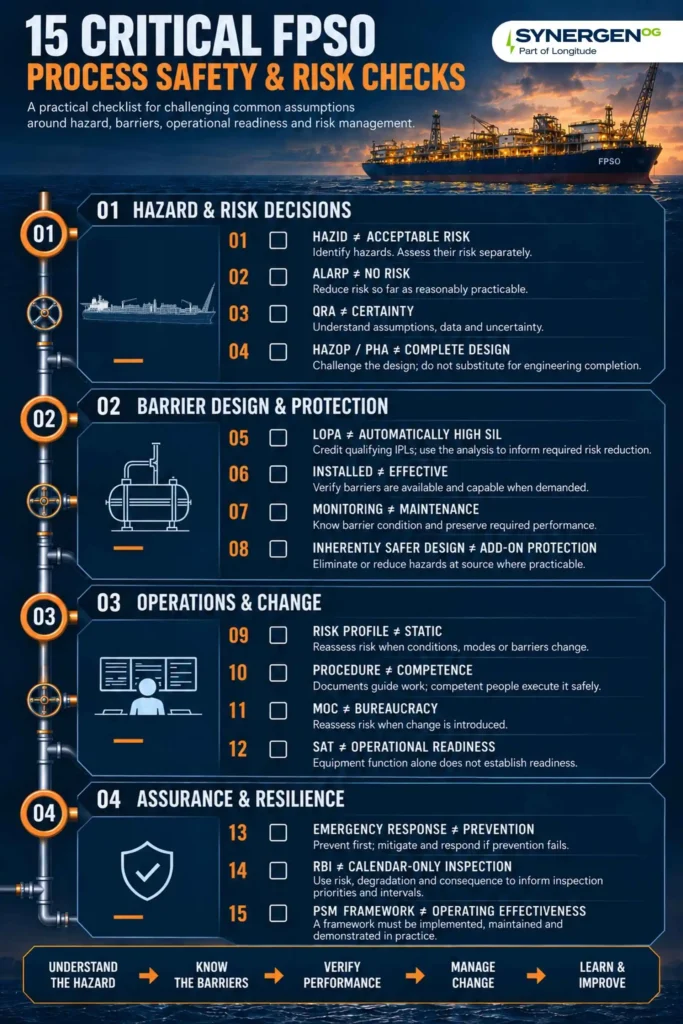
1. HAZID ≠ Acceptable Risk
A Hazard Identification (HAZID) study identifies hazards, accident scenarios and potential safeguards at an appropriate level of detail for the project stage. Many HAZID methods also include qualitative risk ranking, but that ranking does not by itself demonstrate that the risk is tolerable or ALARP.
The follow-on question is whether the identified scenarios have been assessed with sufficient rigour and whether the selected risk-reduction measures satisfy the organisation’s risk criteria and applicable legal or regulatory expectations. A closed HAZID workshop is therefore evidence that hazard identification has been performed – not proof that major-accident risk is adequately controlled.
2. ALARP ≠ Zero Risk
As Low As Reasonably Practicable (ALARP) does not mean eliminating every conceivable risk. Under UK practice, the presumption is in favour of implementing further risk reduction unless the sacrifice in money, time or trouble would be grossly disproportionate to the benefit achieved. Good practice and inherently safer options should be considered before relying on cost-benefit arguments.
Where a hazard remains, residual risk normally remains as well. The defensible question is not “Have we reached zero risk?” but “What more could reasonably be done to reduce the risk, and why has any further measure not been adopted?”
3. LOPA ≠ High SIL
Layer of Protection Analysis (LOPA) is a semi-quantitative method that evaluates one cause-consequence scenario at a time. It combines initiating-event frequency with the risk reduction credited to safeguards that satisfy independent protection layer (IPL) criteria, then compares the mitigated scenario risk with the applicable target or criterion.
LOPA may show that existing IPLs are adequate, that another independent layer is needed, or that a safety instrumented function (SIF) is an appropriate risk-reduction measure. If a SIF is selected, the required risk reduction can inform its Safety Integrity Level (SIL) requirement. A high SIL is not the default outcome of LOPA, and SIL is assigned to a SIF – not casually to an entire control or shutdown system.
4. Installed Safety System ≠ Demonstrated Protection
An ESD system, SIS, fire-and-gas system, deluge system or shutdown valve provides risk reduction only when its safety function and performance requirements are defined, maintained and demonstrated over the asset life cycle.
Commissioning and SAT records establish an important baseline, but they do not demonstrate current condition several years later. Proof testing, inspection, preventive maintenance, impairment control, demand history, failure data, functional testing and verification against the performance standard are what support an ongoing claim of protection.
5. Risk Profile ≠ Constant Condition
Risk changes with operating mode, production conditions, temporary equipment, maintenance, barrier impairments, SIMOPS, weather/marine conditions and organisational or competence changes that are material to the hazard controls. A QRA or safety case provides a baseline representation; it cannot substitute for operational risk management when the plant condition changes.
That does not mean every routine change requires a new QRA. Operators should define proportionate triggers for MOC, operational risk assessment, SIMOPS review, degraded-barrier management or formal revalidation when conditions move outside the assessed or authorised envelope.
6. Procedure ≠ Competence
A procedure defines an expected way of performing a task. Competence combines knowledge, skill, experience and the ability to recognise and respond to abnormal conditions. The two support each other but are not substitutes.
For safety-critical activities, assurance should therefore test more than whether personnel can find the latest procedure. Training, assessment, drills, supervision and experience should demonstrate that people can execute the task and respond safely when the real situation does not follow the ideal sequence in the document.
7. QRA ≠ Certainty
Quantitative Risk Assessment (QRA) uses models, data and assumptions to estimate frequencies and consequences and to support comparison of risk-reduction options. Its value is disciplined decision support, not prediction of exactly what will happen on a particular day.
Good QRA practice makes important assumptions visible and tests sensitivity to uncertain inputs such as leak frequencies, ignition probabilities, occupancy, weather, escalation assumptions and reliability data. The result should be interpreted with engineering judgement and uncertainty in mind, especially where the decision is close to a risk criterion.
8. Barrier Monitoring ≠ Maintenance
Barrier monitoring tells the organisation whether a safety-critical function or element is healthy, degraded, inhibited or failed. Maintenance is one of the activities used to preserve or restore required performance. Verification provides a further check that the barrier and its assurance activities are actually meeting the specified standard.
A dashboard can therefore be valuable, but it is not a control measure by itself. The critical questions are whether degradation is detected promptly, whether the associated risk is assessed, whether compensating measures are adequate, and whether repair or restoration is managed to an appropriate timescale.
9. Inherently Safer Design ≠ Add-On Protection
Inherently safer design reduces or removes the hazard rather than adding another layer to manage it. Typical principles include minimisation, substitution, moderation and simplification. On an FPSO, examples might include reducing hazardous inventory, eliminating unnecessary connections, choosing less severe operating conditions where practicable, or changing layout to reduce escalation potential.
Inherently safer options generally have the greatest leverage early in concept and FEED, when layout and process choices are still flexible. Opportunities can still exist later in the life cycle, but retrofit changes may require greater engineering, shutdown time and cost. The important point is to ask whether the hazard can be reduced at source before relying solely on alarms, procedures or active protection.
Read: FPSO Risk Assessment by Project Stage: From Concept and FEED to First Oil and Operations
10. MOC ≠ Bureaucracy
Management of Change (MOC) is the control process used to make sure a technical, procedural, software, temporary or organisational change does not introduce unmanaged risk. A robust MOC addresses the technical basis, safety impact, affected documents, training, approvals, testing and conditions for start-up or return to service.
Good systems also define what qualifies as replacement in kind and how temporary changes are controlled and time-limited. The purpose is not to route every routine action through the same workflow; it is to ensure that changes capable of altering the hazard or a barrier are recognised, assessed and communicated before implementation.
11. Emergency Response ≠ Prevention
Prevention barriers reduce the probability of a top event or major consequence. Emergency-response and mitigation arrangements act after prevention has failed or a hazardous condition has developed. Strong emergency response is essential, but it does not compensate for weak containment, poor isolation or ineffective ignition control.
An effective major-accident strategy therefore uses layers: prevent where reasonably practicable, detect promptly, control and isolate, mitigate escalation, protect personnel, and provide credible escape, evacuation and rescue arrangements for the residual scenario.
12. SAT ≠ Operational Readiness
A Site Acceptance Test (SAT) confirms that defined acceptance criteria for the tested equipment or system have been met at site. It is necessary evidence, but its scope may be much narrower than the question “Are we ready to start and operate safely?”
Operational readiness or a pre-startup safety review (PSSR) considers the integrated installation: construction against design, completion and control of punch items, procedures, training and competence, hazard-study actions, MOC status, safety-system readiness, utilities, emergency arrangements, documentation and interfaces between systems. Equipment can pass SAT while the facility is still not ready for safe operation.
13. HAZOP / PHA ≠ Complete Design
A HAZOP or other Process Hazard Analysis challenges the design, identifies deviations or accident scenarios and raises recommendations or actions. Completing the workshop does not mean the design is complete, and an action register does not show that the associated risk has been addressed.
Actions should be tracked to documented resolution through the project’s assurance gates. Depending on the regime, that may mean implementation, redesign, further analysis, or a technically justified decision not to adopt a recommendation. Before startup, unresolved items that could affect safe operation must be controlled in accordance with the applicable PSSR, MOC, and project governance requirements.
14. RBI ≠ Fixed-Interval Inspection
Risk-Based Inspection (RBI) uses risk to focus inspection resources and define an inspection strategy for pressure-containing equipment. API RP 580 provides the elements of an RBI program; probability of failure and consequence of failure are central, with damage mechanisms, inspection history, effectiveness and uncertainty informing the assessment.
An RBI plan can still produce calendar dates or inspection intervals. The distinction is that the interval and inspection scope are justified by risk and degradation information rather than being applied uniformly to every item. Two nominally identical vessels can therefore have different inspection plans when service conditions, damage mechanisms or consequences differ.
15. PSM Compliance ≠ Demonstrated Process-Safety Performance
A Process Safety Management framework defines the management practices needed to control major process hazards. OSHA 29 CFR 1910.119, where applicable, includes elements such as process safety information, PHA, operating procedures, training, mechanical integrity, PSSR, MOC, incident investigation and compliance audits. Other jurisdictions use different regulatory and safety-case frameworks.
Completing required documentation or passing an audit does not, by itself, prove that barriers are healthy on the current shift or that work is being executed as intended. Effective PSM requires field implementation, learning from weak signals and events, timely closure of deficiencies, management of impairments and recurring assurance of safety-critical performance.
How to Turn These Concepts Into Action on an FPSO
The practical objective is to connect major-accident analysis to the asset’s condition today. Six actions make that connection stronger:
- Define major-accident scenarios and top events clearly. Do not force every hazard into an LOPC bowtie. Identify the process, marine, structural, stability, stationkeeping, offloading and other top events relevant to the asset.
- Map barriers to each scenario and define performance standards. For every critical barrier, specify the safety function and measurable criteria such as capacity, response time, availability/reliability, integrity and survivability as appropriate.
- Manage degraded barriers as risk conditions. Know when safety-critical equipment or human/operational barriers are impaired, assess the increased risk, apply compensating measures where justified and restore the barrier promptly.
- Use proportionate reassessment triggers. Material process changes, temporary modifications, abnormal operating modes, significant SIMOPS, excursions outside approved limits and major barrier impairments should trigger the appropriate MOC or operational risk review.
- Verify competence as well as documentation. For safety-critical roles, test whether personnel can perform the function under credible abnormal conditions, not merely whether training records and procedures exist.
- Close the learning loop. Use incidents, near misses, test failures, barrier-performance data, audit findings and operational experience to update risk assessments, performance standards, maintenance strategies and operating controls.
The aim is not to create more paperwork. It is to ensure that the risk picture used to justify operation remains connected to current equipment condition, operating mode, people and work activity.
Key Takeaways
- Start with the scenario. A barrier only has meaning in relation to a defined threat, top event and consequence.
- Use the right tool for the right question. HAZID, HAZOP, LOPA, QRA, SIL determination, MOC and RBI solve different parts of the risk-management problem.
- Specify performance, then verify it. Installed equipment or a completed procedure is not the same as a demonstrated safety function.
- Treat risk as operationally dynamic. Barrier impairments, SIMOPS, temporary changes and abnormal modes can materially alter risk even when the baseline safety case has not changed.
- Keep prevention and mitigation distinct. Emergency response is essential, but the strongest major-accident strategy prevents the initiating event or top event wherever reasonably practicable.
- Make assurance evidence-based. Use tests, inspections, competence evidence, performance indicators and independent verification to confirm that critical barriers continue to meet their standards.
Final Thoughts
FPSO process safety and risk concepts become valuable when they drive decisions, not when they remain terminology in a safety case. HAZID is not acceptable risk. ALARP is not zero risk. LOPA is not a shortcut to a high SIL. A completed HAZOP is not a completed design. An installed safety system is not demonstrated protection.
The common thread is barrier performance. For each major-accident scenario, operators need to know what must work, how well it must work, what evidence demonstrates that performance, and what happens operationally when the barrier is degraded. That discipline is what turns risk assessment from a project deliverable into an operating control.
SynergenOG‘s process safety and risk engineers can review major-accident scenarios, barrier performance standards, HAZID/HAZOP closeout, degraded-barrier management and verification programs ahead of a safety-case update, project assurance gate or operational review.
References:
- https://www.hse.gov.uk/offshore/piper-alpha-disaster-public-inquiry.htm
- https://www.hse.gov.uk/humanfactors/topics/shift-handover.htm
- https://www.hse.gov.uk/foi/internalops/hid/pmtech12.pdf
- https://www.hse.gov.uk/offshore/assets/docs/ed-evacuation-escape-rescue.pdf
- https://www.iogp.org/bookstore/product/standardization-of-barrier-definitions/
- https://www.iogp.org/bookstore/product/asset-integrity-the-key/
- https://ccps.aiche.org/resources/tools/lopa
- https://webstore.iec.ch/en/publication/61289
- https://www.api.org/products-and-services/standards/standards-plan
- https://www.osha.gov/laws-regs/regulations/standardnumber/1910/1910.119
Technical Note: Regulatory requirements and terminology vary by jurisdiction, flag state, coastal state, operator management system and project specification. The article uses recognised industry concepts for general professional guidance; asset-specific decisions should be checked against the governing regulations, safety case, design basis and company engineering standards.