
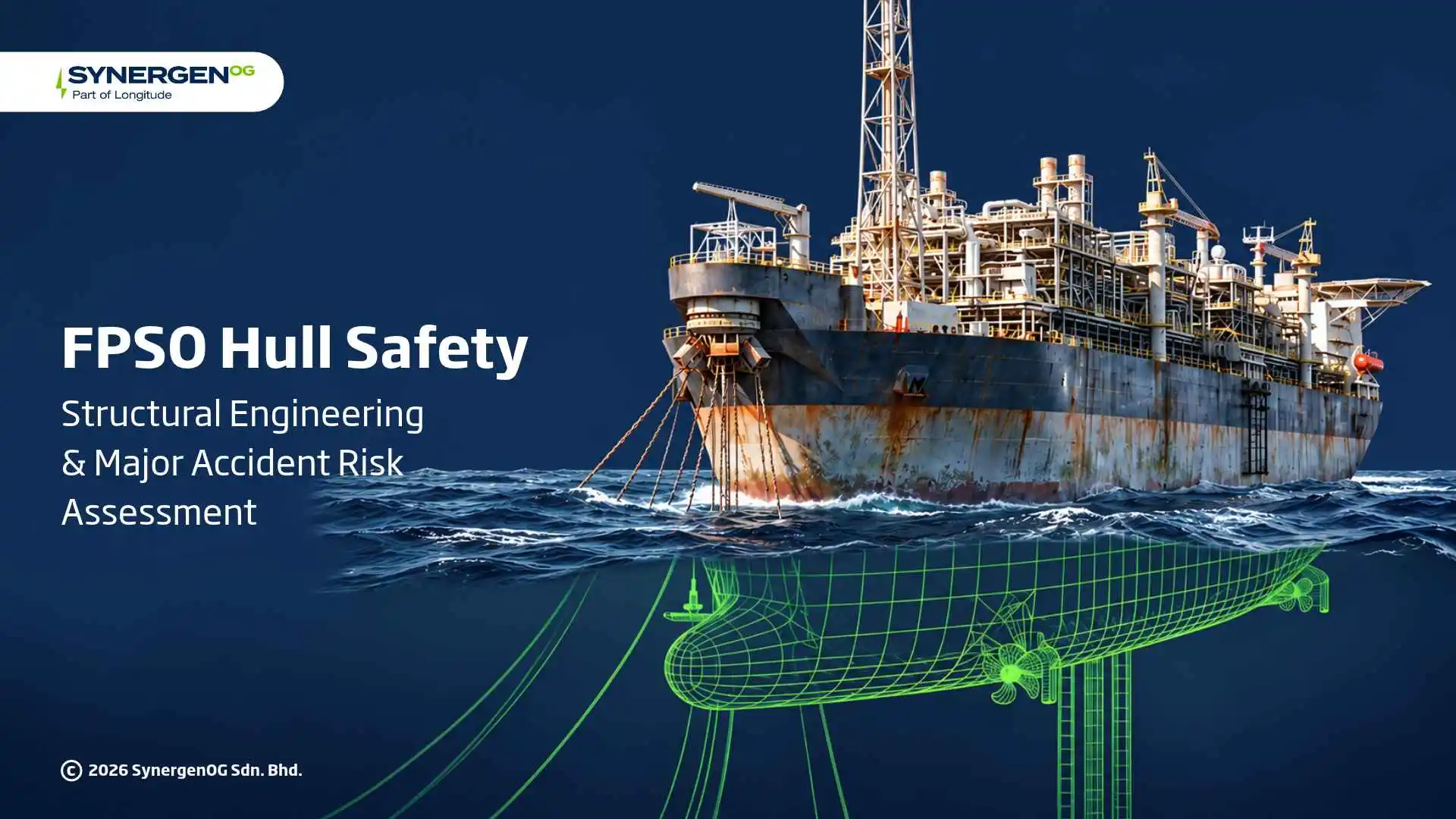
| FPSO hull safety is achieved by combining sturdy structural design with lifecycle integrity management. Operators assess fatigue, corrosion, buckling, fracture, and ultimate-strength risks, then use risk-based inspection and monitoring to prioritize inspection, repair, and life-extension decisions. Longitude engineers the hull for strength and fatigue life, SynergenOG assesses the risks to it, and together they keep one coordinated hull safety plan from concept to life extension, read more here. |
An FPSO hull supports storage tanks, topside equipment and marine systems. It must maintain strength, stability and watertight integrity throughout service. Fatigue, corrosion, collision and modifications can weaken that protection.
Hull safety depends on two kinds of evidence. Structural engineering tests what the vessel can withstand. Risk assessment examines how credible events could harm people, the environment or the asset. Longitude and SynergenOG provide distinct services that address these connected needs.
Why hull integrity matters to FPSO safety
What can damage an FPSO hull?
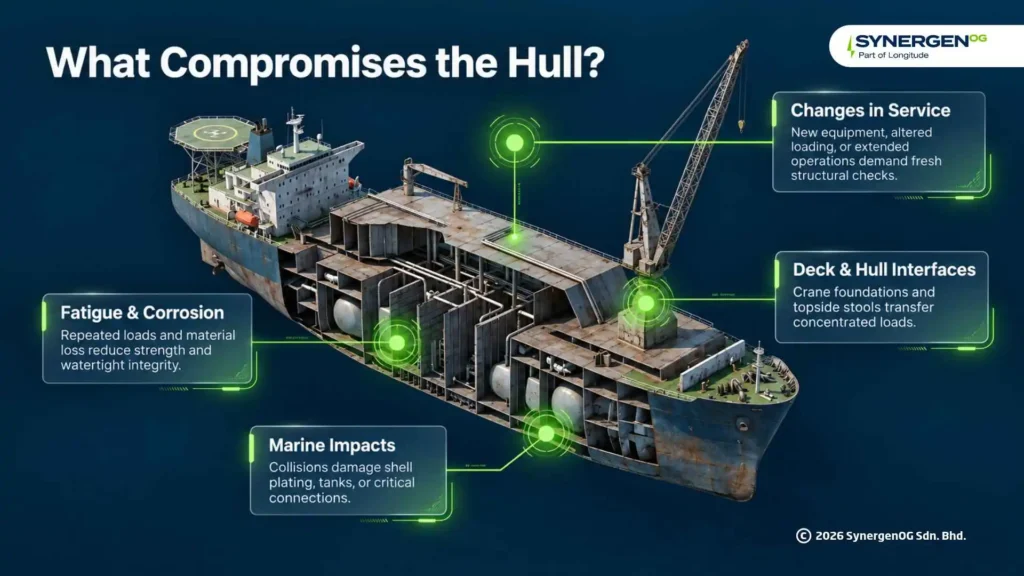
An FPSO hull contains strength members, tanks, watertight boundaries and equipment supports. Each serves a different function. Four areas need particular attention.
- Fatigue and corrosion. Repeated loads and material loss can reduce strength or watertight integrity.
- Marine impacts. A collision can damage shell plating, tanks or critical connections.
- Deck and hull interfaces. Crane foundations, topside stools and equipment support transfer concentrated loads into the structure.
- Changes in service. New equipment, altered loading or extended operations may require fresh structural checks.
How does structural assessment differ from risk assessment?
A structural assessment checks strength, fatigue, stability and response to defined loads. It identifies weak details and may set repair or operating limits. A risk assessment examines credible incidents, potential consequences and the safeguards needed to control risk. Neither replaces the other.
Not every defect creates a major accident hazard. The concern is whether failure could lead to flooding, loss of stability, loss of containment or another serious event. That distinction helps focus engineering and risk reviews on the most important areas.
Read: FPSO Safety – Role pf PSM
Longitude’s FPSO hull and marine engineering capabilities
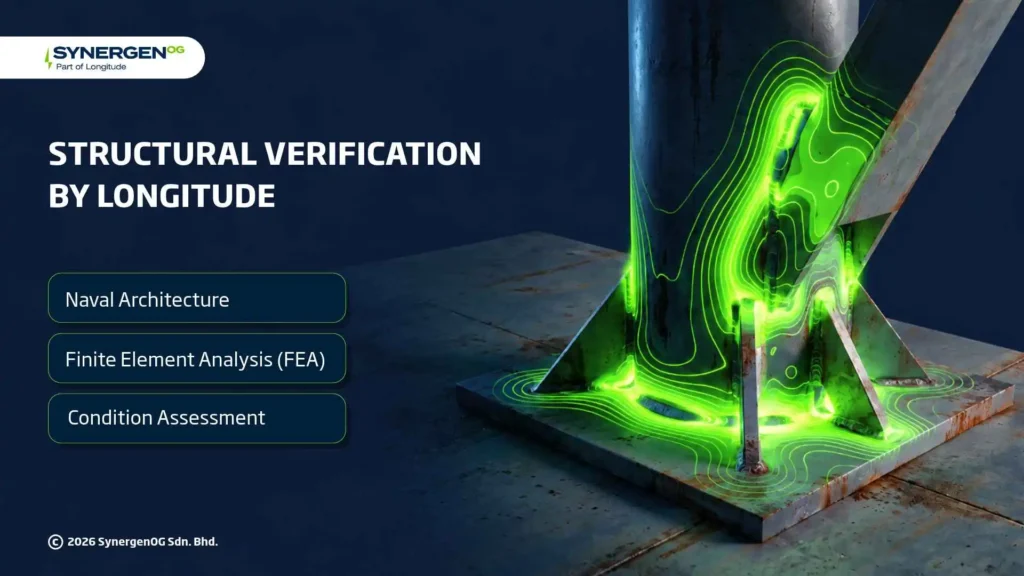
Naval architecture and structural verification
Longitude provides naval architecture, structural design and analysis for marine assets. Its services cover vessel design, modifications and conversions. Structural checks can assess global hull behaviour and local details that carry loads from tanks, decks and topsides.
Finite element analysis (FEA) can provide detail at critical connections. This may include crane pedestals, module supports and other hull interfaces. Fatigue analysis is important where repeated loads act on these details.
Condition assessment and life-extension engineering
Longitude also offers fitness-for-service reviews, condition assessments and life-extension studies. Its published services include structural reassessment, fatigue analysis, corrosion evaluation and integrity management. These services help owners assess remaining capacity and plan repairs or inspections.
Explore Longitude’s Ship Design and Conversion, Upgrade & Retrofit services for design and modification work. For operating assets, see its Life Extension and Asset Integrity & Reliability services.
SynergenOG’s process safety and technical risk capabilities
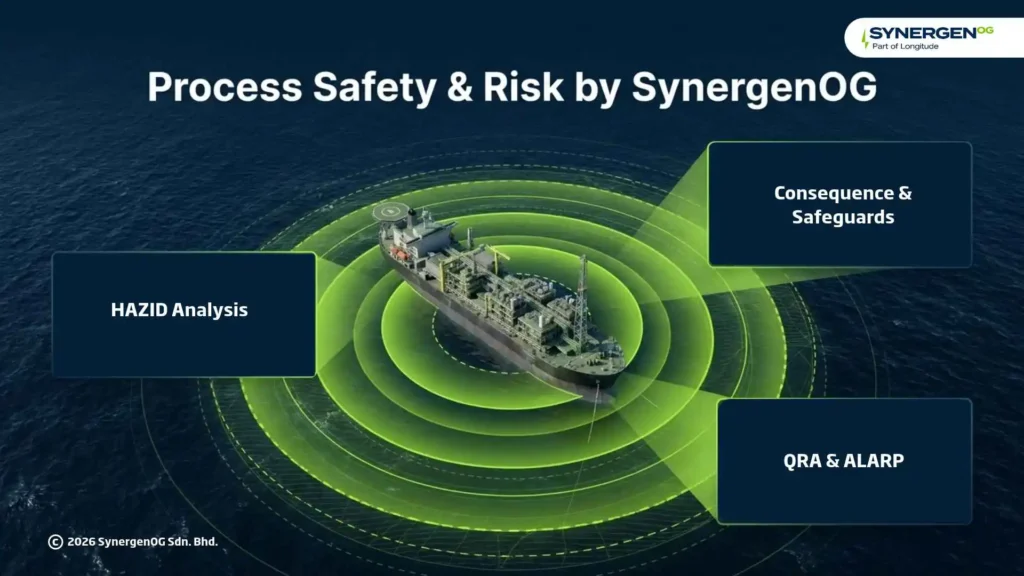
HAZID and non-hydrocarbon hazard analysis
SynergenOG provides hazard identification (HAZID) studies and technical risk assessment. Its non-hydrocarbon hazard scope includes boat transport incidents, dropped objects, structural failure, mooring failure and loss of stability. These scenarios can affect major accident risk when critical hull functions are involved.
HAZID considers what could go wrong, the consequences and the safeguards already in place. Findings can inform vessel approach controls, lifting practices, impact protection and emergency arrangements. Controls must suit the FPSO layout and operating conditions.
QRA, ALARP and safeguard decisions
SynergenOG also offers quantitative risk assessment (QRA) and ALARP assessment support. QRA uses frequency and consequence estimates to examine risk drivers when suitable data exist. ALARP considers whether further risk reduction is reasonably practicable under the applicable framework.
Does every collision or dropped-object study need QRA?
No. A focused HAZID and structural check may be enough for some decisions. QRA is useful when numerical estimates could change the choice of safeguards. The method should match the hazard, available evidence and decision being made. [8, 15]
Explore SynergenOG’s Process Safety Management and Technical Risk Management services for hazard and safeguard studies. Its QRA service supports decisions that need quantitative risk estimates.
Where engineering and risk assessment connect
Ship collision: From hull damage to risk controls
A supply vessel may strike an FPSO after losing manoeuvring control. A collision review should consider credible impact conditions, possible structural damage and escalation. Lloyd’s Register guidance addresses collision scenarios, representative loads and structural consequences.
Structural response to an impact
Longitude’s structural engineering capabilities can support checks of shell plating, tank boundaries and nearby supports. The assessment can examine damage, remaining capacity and effects on critical connections. Its assumptions must reflect the vessel and the scenario.
Hazard escalation and prevention
SynergenOG’s HAZID and technical risk capabilities can examine how a collision might affect flooding, containment or safety functions. The findings can guide vessel approach procedures, operating limits or impact protection. Each measure needs assessment against the actual hazard.
Engineering findings can change the risk assessment. Risk findings may also identify new impact locations or load cases. This exchange helps make the final safeguards more relevant.
Dropped objects: More than an impact calculation
A dropped load may damage a deck, support or exposed hull component. An impact calculation tests the structure under a defined load. It does not explain why the load may fall or which activities increase exposure.
Longitude can assess the structural response. SynergenOG can examine dropped-object scenarios and their consequences. These findings may support changes to lifting routes, exclusion zones, local protection or reinforcement.
Also Read: FPSO Risk Assessment by Project Stage
Managing hull integrity during operations and life extension
Keep structural and inspection evidence current
Fatigue, corrosion, defects and repairs can change an FPSO’s condition. UK HSE and OPRED have highlighted excessive corrosion, inspection backlogs and loading limits that were not reviewed for late-life operation. Owners need current evidence of hull condition and structural limits.
Longitude’s integrity and life-extension services can support reviews of remaining strength, corrosion margins, fatigue life and repair needs. Risk-based inspection (RBI) can help set priorities based on damage mechanisms and consequences.
Can risk-based inspection replace class surveys?
Not automatically. Any alternative inspection scheme needs acceptance under the relevant classification and regulatory framework. Lloyd’s Register provides guidance for approved hull RBI schemes on eligible floating offshore units. RBI is not unrestricted permission to defer a mandatory survey.
When should an FPSO hull risk assessment be updated?
Revisit the assessment after major corrosion, fatigue damage, a serious incident or a significant modification. Changes in loading, operating conditions or planned life extension can also warrant a review. The depth of the study should reflect the change and its possible consequences.
Longitude’s engineering work can establish updated structural limits. SynergenOG’s risk services can assess whether those changes affect major accident hazards or safeguards. This link is useful when a defect could affect flooding, stability or containment.
Setting the right scope for an FPSO hull safety review
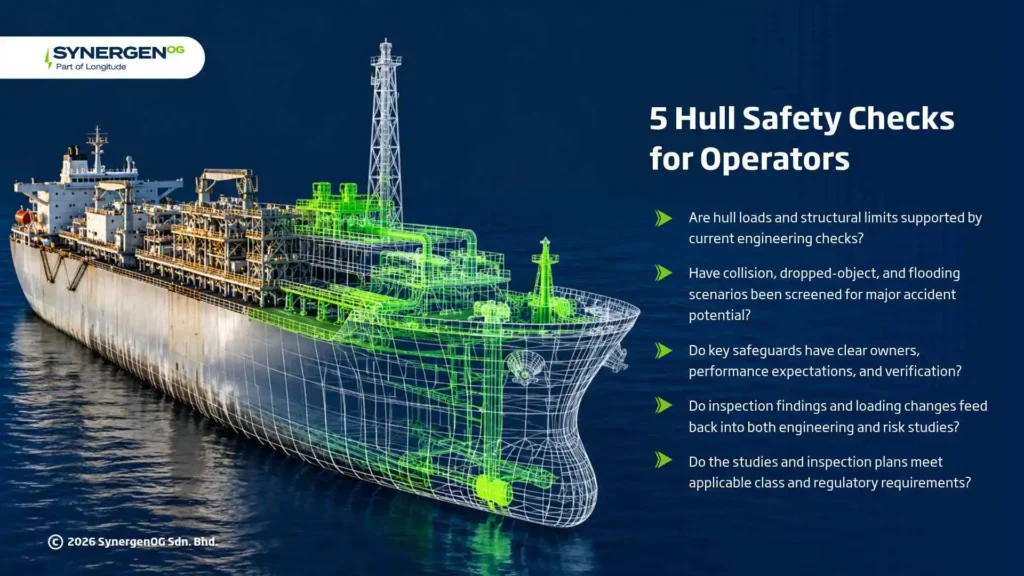
5 checks for owners and operators
Use these questions during design, conversion, modification, operations or life-extension planning:
- Are hull loads, structural limits and fatigue-critical details supported by current engineering checks?
- Have collision, dropped-object, flooding and structural-failure scenarios been screened for major accident potential?
- Do key safeguards have clear owners, performance expectations and verification needs?
- Do inspection findings, repairs and loading changes feed back into both engineering and risk studies?
- Do the studies and inspection plans meet applicable class, regulatory and assurance requirements?
Turn study results into practical action
The aim is not to commission more studies than needed. A useful scope defines the relevant load cases, hazards, evidence gaps and decisions. Some issues need a targeted structural check and HAZID. Others justify detailed impact analysis, QRA or a wider life-extension study.
Longitude addresses hull performance, marine interfaces and structural condition. SynergenOG addresses credible hazards, consequences and safeguards. A project-specific scope can link both sets of findings without treating engineering verification and risk assessment as the same task.
For hull strength, fatigue, conversion or life extension, review Longitude’s structural and vessel design services or life-extension engineering. These services can help define the structural evidence needed for an FPSO project. For HAZID, vessel collision hazards, dropped-object risk or wider major accident assessment, review SynergenOG’s process safety services and technical risk services. Its QRA capabilities can be considered where quantitative analysis would inform the decision.
Technical references
1. https://www.hse.gov.uk/offshore/assets/docs/is2-2025.pdf
2. https://www.iso.org/standard/63062.html
3. https://www.irclass.org/media/7345/guidelines-on-risk-based-inspection_march-2024.pdf
4. https://www.lr.org/en/knowledge/lloyds-register-rules/guidance-notes/guidance-notes-for-collision-analysis/
5. https://www.lr.org/en/knowledge/lloyds-register-rules/guidance-notes/guidance-notes-for-risk-based-inspection-of-hull-structures/
6. https://www.hse.gov.uk/offshore/structuralintegrity.htm
7. https://www.lr.org/en/knowledge/lloyds-register-rules/guidance-notes/guidance-notes-for-fatigue-assessment-of-topside-structures-on-floating-offshore-units/
8. https://www.hse.gov.uk/offshore/assets/docs/sheet32006.pdf
9. https://longitude-engineering.com/what-we-do/ship-design/
10. https://longitude-engineering.com/what-we-do/ship-design/conversion-upgrade-retrofit/
11. https://longitude-engineering.com/what-we-do/facilities-subsea/life-extension/
12. https://longitude-engineering.com/what-we-do/facilities-subsea/asset-integrity-reliability/
Disclaimer: This article is for general information only. It is not engineering, safety or legal advice. Hull safety requirements depend on each unit’s design, class society rules, regulations and operating conditions. Always consult qualified engineers and your class society and regulator before making decisions.