
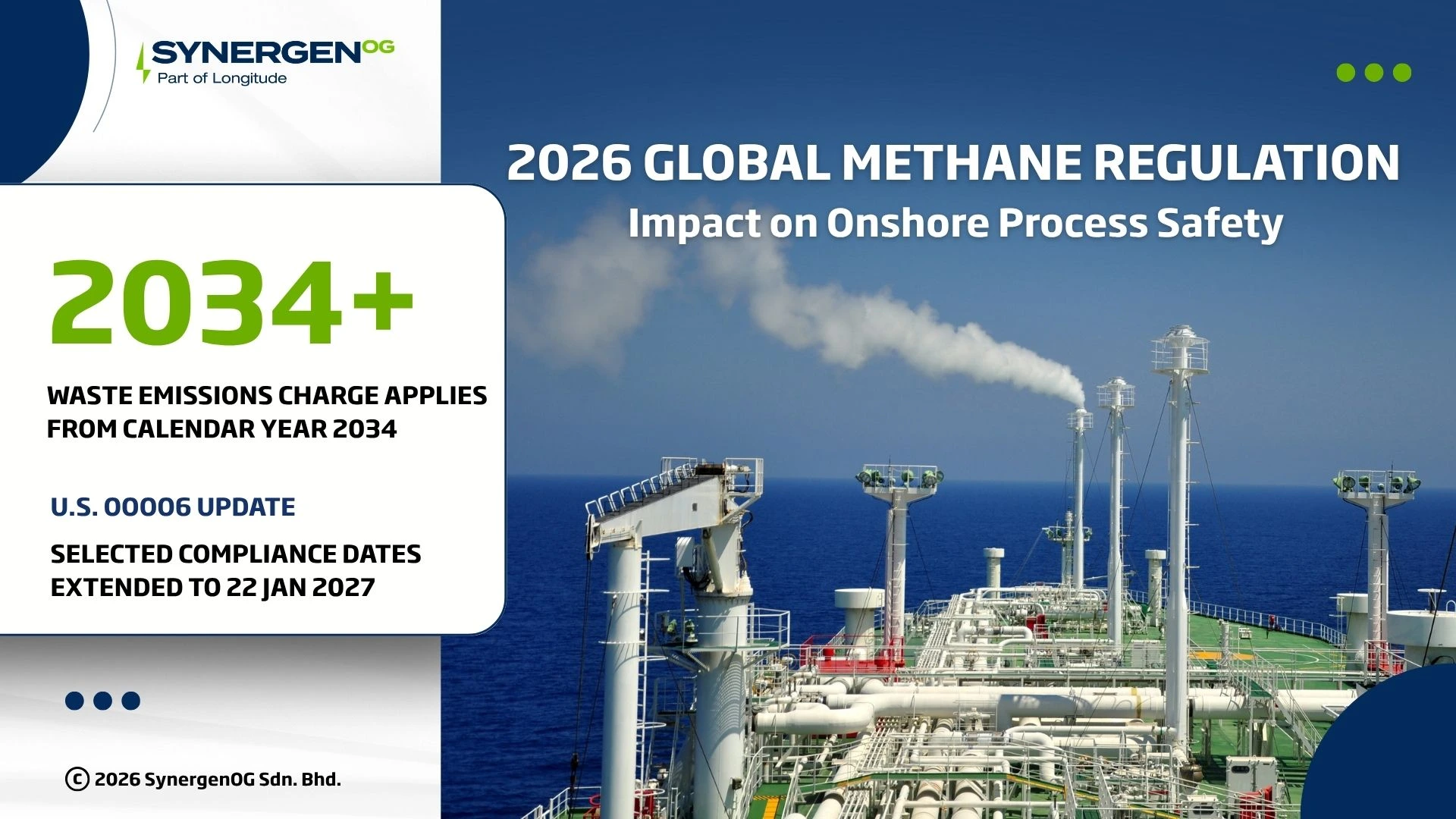
| What is the 2026 methane regulation? As of February 2026, the EU has effectively banned routine venting and flaring for fossil fuel operations. Member states are required to implement “effective, proportionate, and dissuasive” penalties for emissions above set thresholds. The U.S. EPA’s OOOOb/c framework includes a third-party Super Emitter Program, but future implementation of that program is currently extended until January 22, 2027. Read full article. |
Updated: 31st Aug 2026
In the past, methane leaks were often viewed primarily as an environmental issue or as a lost-product problem. If a leak didn’t pose an immediate fire or explosion risk, it was often lower on maintenance teams’ priority lists. That mindset is no longer viable.
In 2026, a leak is a leak, whether it’s a massive blow-out or a tiny fugitive emission from a valve stem. The EU Methane Regulation is in force, while U.S. EPA OOOOb/c requirements remain in force subject to extended compliance dates for selected provisions and continuing EPA reconsideration, methane management has become a core pillar of Process Safety Management (PSM).
What Changed in 2026?
1) The 2026 Methane Regulatory Landscape: From Voluntary to Mandatory
By 2026, methane regulation has expanded across multiple jurisdictions, but implementation schedules differ. The EU Methane Regulation and U.S. EPA OOOOb/c rules are two important frameworks, while Canada and other producing countries have also introduced or strengthened mandatory methane policies.
The EU Methane Regulation (2024/1787)
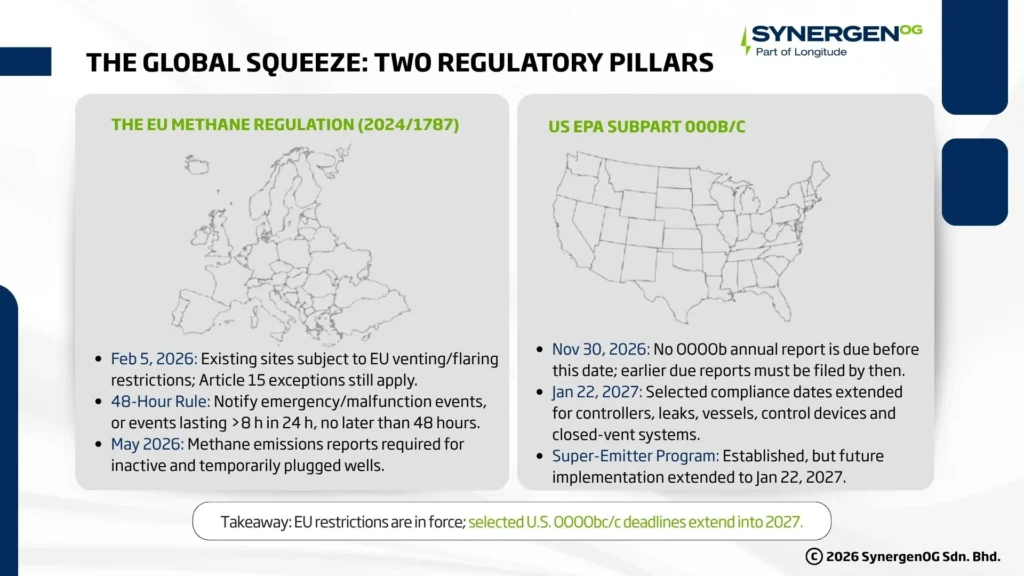
Existing sites were required to comply with the EU Methane Regulation’s venting and flaring restrictions by February 5, 2026. Venting and flaring are generally prohibited except in circumstances expressly allowed by Article 15, including specified emergency, malfunction, safety and operational situations.
Operators must notify competent authorities of venting or flaring caused by an emergency or malfunction, or a single event lasting a total of eight hours or more within a 24-hour period. Notification must be made without delay and no later than 48 hours from the start of the event or from when the operator became aware of it. Furthermore, by May 2026, companies must provide detailed methane emission reports for all inactive and temporarily plugged wells, shifting liability from active production to the asset’s entire lifecycle.
The US EPA Subpart OOOOb/c
NSPS OOOOb remains applicable, but EPA has extended compliance dates for selected requirements. Several requirements relating to control devices, equipment leaks, storage vessels, process controllers and covers/closed vent systems were extended to January 22, 2027, and EPA finalized additional narrow technical revisions on April 4, 2026.
EPA has provided that no OOOOb annual report is due before November 30, 2026; by that date, owners and operators must submit reports that otherwise would have been due earlier. This reporting deadline should not be presented as the compliance date for every zero-emission process-controller or control-device requirement. EPA’s Super Emitter Program is established under OOOOb/c, but future implementation is extended until January 22, 2027. EPA-approved technologies and certified third-party processes remain part of the program framework.”
The Financial Hit: The federal Waste Emissions Charge should not be described as a current 2026 $1,500-per-ton liability. EPA states that the 2024 WEC implementing rule is no longer in effect, and the governing statute now applies the charge to emissions reported for calendar year 2034 and each year thereafter. For a mid-sized facility, an undetected leak is now a massive financial liability, as outlined in the Congressional Research Service reports on the Methane Emissions Charge.
2) Integrating Methane Abatement into PSM
Historically, Process Safety Management (PSM) focused on “Loss of Containment” (LOC) leading to catastrophic fires or explosions. In 2026, the definition of LOC has expanded to include “Loss of Compliance”, where even a non-flammable micro-leak is treated as a process safety failure due to its regulatory and environmental impact.
Redefining HAZOP
The most practical change for engineers in 2026 is how safety studies are conducted. Traditional HAZOP (Hazard and Operability) sessions used to focus almost exclusively on high-pressure scenarios that could lead to fire or explosion.
Now, engineers are adding an “Environmental Node” to these HAZOP studies, looking at every valve and seal for “sealing integrity” during normal operations to avoid regulatory breaches. This shift reflects the broader integration of security and safety risk management discussed in recent industry studies, such as Ab Rahim et al. (2025).
Using LOPA for Methane
Methane detection can form part of a credited protection layer only when the complete protective function – detection, logic/alarm, required human or automatic action, and supporting management system – satisfies the applicable IPL criteria for independence, functionality, integrity, reliability and auditability. A sensor by itself should not automatically be credited as an IPL. It is no longer about “feeling” safe; it is about having the data to prove it. This moves inventories toward being “measurement-informed” rather than based on simple estimates.
2) The Technical Headache: Flare Systems
One of the biggest challenges of the “Zero-Routine Venting” mandate is the physical pressure it puts on equipment. To stop venting, many operators are installing Flare Gas Recovery Units (FGRUs). However, routing gas back into a closed system increases backpressure in the relief headers. If not carefully modeled, this pressure can prevent Pressure Safety Valves (PSVs) from opening correctly during an emergency.
This complex interaction between environmental controls and safety systems is a key focus of current Process Safety engineering research.
3) The Move to Continuous Integrity
The old way of doing LDAR (Leak Detection and Repair) was sending a technician out once a quarter with a “sniffer.” In 2026, snapshot measurements are seen as insufficient because they fail to capture the temporal variability and “heavy-tailed” nature of intermittent emissions, as demonstrated in the study Multiscale Methane Measurements at Oil and Gas Facilities (Wang et al., 2022).
The 2026 Tech Stack:
- Fixed Optical Gas Imaging (OGI): Cameras that provide 24/7 visual monitoring using AI to spot gas plumes instantly.
- Continuous Emissions Monitoring Systems (CEMS): These systems provide high sampling frequency, which is key to accurately accounting for short-duration and high-volume events often missed in snapshot surveys.
- Site-Level Reconciliation: Operators are now reconciling source-level data with site-level measurements (Top-Down vs. Bottom-Up) to meet the strictest reporting levels, such as OGMP 2.0 Level 5. The necessity of this reconciliation is detailed in Toward Multiscale Measurement-Informed Methane Inventories (Daniels et al., 2023).
Why This Actually Helps Your Bottom Line
It is easy to see these rules as a burden, but the best-performing companies in 2026 use them as a competitive advantage.
- More Product to Sell: Captured methane is a sellable asset rather than a waste product.
- Lower Insurance Costs: Better leak control and asset integrity can reduce product loss and operational risk. Any statement that methane intensity directly lowers insurance premiums should be supported by a named insurer, broker, underwriting methodology or empirical study.
- Market Access: Natural gas exports now frequently require “Low Methane Intensity” certification to access premium markets, especially in Europe. The economic implications of these regulations, particularly for regions like Poland, have been extensively analyzed by Instrat (2024).
Conclusion
The 2026 methane regulations have proven that Safety and Sustainability are two sides of the same coin. A plant that leaks methane is a plant that lacks integrity.
For onshore operators, the path forward requires moving beyond “check-the-box” compliance. It requires a holistic engineering approach, integrating advanced relief system modeling, digital monitoring, and a revamped PSM framework. Operators that integrate methane management with asset integrity, relief-system design, monitoring and compliance management will be better positioned to meet jurisdiction-specific regulatory requirements and reduce operational and environmental risk.”
Is your facility ready for the 2026 Methane Mandates? SynergenOG provides expert engineering consulting in Process Safety, Technical Risk, and Asset Integrity. Contact us today for a comprehensive regulatory gap analysis.
References:
- https://unece.org/sustainable-energy/events/eu-methane-regulation-global-implications-benefits-and-challenges
- https://doi.org/10.3390/pr13020392
- https://doi.org/10.1016/j.jchas.2009.05.002
- https://doi.org/10.1021/acs.est.3c01121
- https://www.epa.gov/system/files/documents/2025-01/axpc-petition-for-review-wec.pdf
- https://instrat.pl/wp-content/uploads/2025/04/Instrat-Policy-Paper-06-2024_EN.pdf
- https://hdl.handle.net/10419/324425
- https://doi.org/10.1021/acs.est.2c06211
Disclaimer: SynergenOG provides no further commentary on this methane regulatory mandate. This information is derived exclusively from the provided reference data and publicly available sources.