
| Summary: Imagine finalizing your facility design, only to discover late in the project that your layout cannot withstand a credible explosion scenario. This is exactly the kind of costly oversight a FERA study is meant to prevent, but only if it’s conducted at the right time. This is what this article explains: What is a FERA study, and when is it required in oil and gas projects? |
A Fire and Explosion Risk Assessment, commonly known as a FERA study, is typically required when an oil and gas project involves pressurized flammable hydrocarbons, credible release and ignition scenarios, congested or confined layouts, occupied buildings, escalation potential, or regulatory and client requirements for fire and explosion risk control.
In practical terms, FERA is not only a compliance activity. It is a critical process safety study used to determine what could happen if a fire or explosion occurs, how severe the consequences could be, and whether the facility design can safely withstand those events.
Here we explain what a FERA study is, when it is required or strongly recommended, which project conditions trigger it, and how it supports safer oil and gas facility design.
What Is a FERA Study?
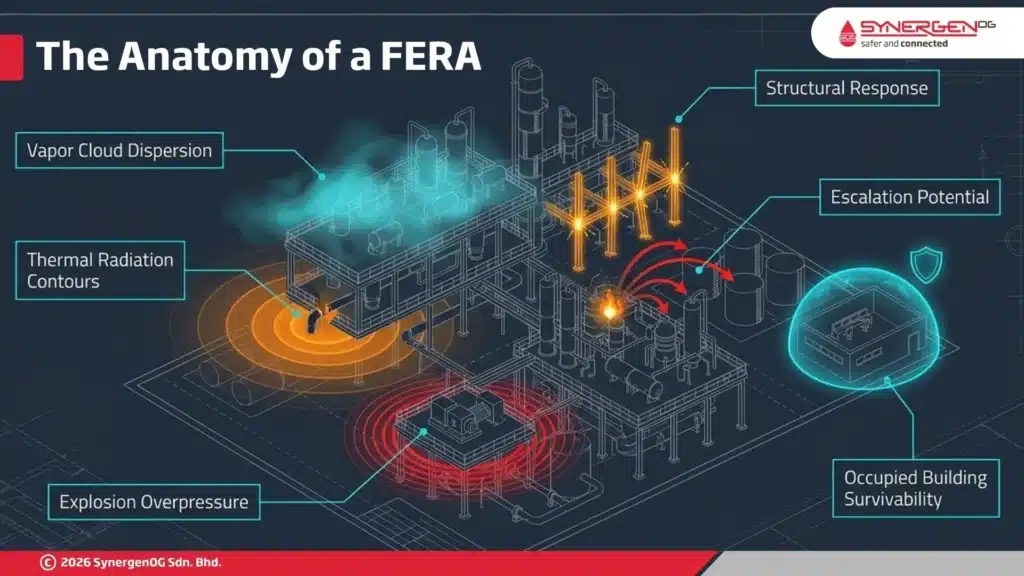
A Fire and Explosion Risk Assessment, or FERA, is an advanced engineering study that evaluates the likelihood and consequences of fire and explosion events in hydrocarbon processing environments.
Unlike high-level hazard identification methods, FERA is based on scenario-driven consequence analysis and, where required, quantitative modeling. It assesses what happens when a flammable material is released, how the vapor or gas cloud disperses, whether ignition is credible, and what impact the resulting fire or explosion may have on people, structures, equipment, escape routes, safety systems, and nearby occupied areas.
Typical FERA outputs include:
- Jet fire and pool fire thermal radiation contours
- Explosion overpressure predictions
- Gas dispersion and vapor cloud behavior
- Escalation potential between process units
- Structural response to blast loads
- Impact on temporary refuge, control rooms, and occupied buildings
- Survivability of critical safety systems
- Inputs for QRA, EERA, layout reviews, and fire protection design
In simple terms, FERA answers one critical question:
If a fire or explosion occurs, what will happen, and can the facility withstand it safely?
When Is a FERA Study Required?
A FERA study is typically required or strongly recommended when an oil and gas facility has credible fire and explosion hazards that could affect personnel safety, asset integrity, emergency response, or regulatory approval.
Common FERA triggers include:
| Project condition | FERA requirement level |
| Pressurized flammable hydrocarbon systems | Usually required or strongly recommended |
| Offshore topside modules with congestion or confinement | Usually required |
| LNG terminals, refineries, and gas processing plants | Usually required |
| Brownfield modifications affecting layout, pressure, inventory, or congestion | Often required |
| Occupied buildings near process hazards | Often required for siting or blast verification |
| Temporary refuge or control room exposure | Often required |
| Low-pressure, non-flammable utility systems | Usually not required |
| No credible ignition, escalation, or occupied-area impact | May not be required |
FERA is not automatically mandatory for every project. However, where hydrocarbons are present under pressure and credible release, ignition, and escalation scenarios exist, project risk criteria, client specifications, safety case expectations, or recognized engineering good practice usually require a FERA.
Key Triggers that Require a FERA Study
A combination of technical risk, project phase, facility type, regulatory expectations, and client requirements normally triggers FERA. The following situations are the most common reasons a FERA study becomes necessary.
1. New Greenfield Oil and Gas Projects
Greenfield projects are among the strongest triggers for FERA because the facility is still in the design stage. At this point, the project team can still influence layout, separation distances, blast wall requirements, fire protection strategy, equipment orientation, evacuation routes, and occupied building locations.
In greenfield projects, FERA is typically required because:
- There is no existing fire and explosion risk baseline
- Equipment layout and spacing are still flexible
- Structural design may need to account for blast loads
- Fire protection systems are being defined
- Temporary refuge and occupied buildings must be assessed
- Project approval may require evidence of major accident hazard control
For example, in an offshore production platform, gas releases may accumulate in congested topside modules. Without FERA, the project team may not know whether a credible explosion could generate overpressures that damage structural elements, safety-critical equipment, or escape routes.
Read: Offshore Safety Management – When & How
Similarly, LNG terminals, refineries, petrochemical units, and gas processing plants often contain large inventories of flammable material. FERA helps the design team understand where fires and explosions could occur, how far the effects could extend, and which design controls are needed to reduce risk.
Conducting FERA during FEED or early detailed design is especially valuable because design changes are easier and less costly before construction begins.
2. Brownfield Modifications
Brownfield projects are another major trigger for FERA. Existing facilities were designed based on original assumptions about inventory, pressure, process conditions, equipment layout, congestion, occupancy, and operating philosophy. When these assumptions change, the original fire and explosion risk profile may no longer be valid.
A FERA study may be required for brownfield modifications, such as:
- Adding new process units or equipment
- Increasing throughput, pressure, or temperature
- Introducing new hydrocarbon streams
- Modifying piping, vessels, compressors, or separators
- Increasing congestion in existing modules
- Reducing equipment spacing due to layout constraints
- Changing occupied building use or occupancy levels
- Extending facility life beyond the original design intent
A common misconception is that small modifications do not significantly affect fire and explosion risk. In reality, even minor changes can alter release rates, dispersion patterns, congestion, confinement, ignition probability, and escalation behavior.
For example, additional piping or equipment installed in an already congested offshore module can increase explosion severity by restricting gas cloud movement and increasing turbulence. Without FERA, this increased overpressure risk may not be identified until late in the project or after operations begin.
In brownfield environments, FERA helps revalidate the facility’s safety envelope under revised operating conditions.
3. High-Pressure Hydrocarbon Systems
Projects involving pressurized flammable hydrocarbons are strong candidates for FERA because high-pressure releases can produce severe jet fires, vapor clouds, and explosion scenarios.
FERA is commonly required where facilities handle:
- Natural gas
- Condensate
- Crude oil
- LPG
- LNG
- Hydrogen-rich streams
- Flammable refinery gases
- High-pressure hydrocarbon mixtures
The higher the pressure and inventory, the greater the potential release rate and consequence severity. A high-pressure gas release can form a flammable cloud, ignite as a jet fire, or produce an explosion if the cloud accumulates in a congested or confined area.
FERA helps quantify these outcomes and determine whether mitigation is needed, such as layout changes, blowdown, deluge, passive fire protection, blast walls, gas detection, ventilation improvements, or ignition source control.
4. Congested or Confined Layouts
Congestion and confinement are critical factors in explosion risk. Offshore modules, compressor shelters, process skids, pipe racks, and enclosed or semi-enclosed areas can allow flammable gas clouds to accumulate and generate high explosion overpressures if ignited.
FERA is particularly important when a project includes:
- Offshore topside modules
- Compressor modules
- Enclosed or semi-enclosed process areas
- Densely packed pipework
- Equipment installed close together
- Poor natural ventilation
- Blast-sensitive structures or safety systems nearby
In these layouts, simple separation-distance rules may not be enough. FERA provides a more realistic understanding of explosion behavior and supports design decisions for ventilation, layout, blast protection, and emergency response.
5. LNG Terminals, Refineries, and Gas Processing Plants
Certain facility types inherently pose elevated fire and explosion hazards due to their hydrocarbon inventories, operating pressures, process complexity, and potential for escalation.
FERA is commonly required for:
- LNG liquefaction plants
- LNG regasification terminals
- Refineries
- Gas processing plants
- Offshore production platforms
- Floating production units
- Compressor stations
- Petrochemical units
- Gas gathering and separation facilities
These facilities often include multiple credible fire and explosion scenarios, including jet fires, pool fires, flash fires, vapor cloud explosions, and escalation between process areas.
FERA supports safer design by helping the project team:
- Identify major fire and explosion scenarios
- Estimate thermal radiation and blast impacts
- Assess escalation between equipment and units
- Evaluate temporary refuge and occupied building exposure
- Define fire protection and blast protection requirements
- Support QRA and ALARP demonstration
6. Occupied Buildings, Control Rooms, and Temporary Refuge Areas
FERA is often required when occupied buildings, control rooms, accommodation areas, or temporary refuge spaces may be exposed to fire or explosion effects.
This is especially important for:
- Offshore temporary refuge areas
- Central control rooms
- Local equipment rooms
- Operator shelters
- Administration buildings near process units
- Maintenance buildings
- Warehouses and workshops within hazardous zones
The objective is to determine whether personnel inside these buildings could be exposed to unacceptable thermal radiation, blast overpressure, smoke, toxic gas, or impaired escape conditions.
FERA results may be used to support:
- Occupied building siting studies
- Blast-resistant design
- Temporary refuge integrity assessment
- Escape, evacuation, and rescue planning
- Emergency response strategy
- Control room survivability assessment
Where occupied buildings are located close to hazardous process areas, FERA provides essential data to determine whether relocation, structural strengthening, shielding, or occupancy controls are required.
7. Regulatory, Safety Case, and Client Requirements
FERA is often driven by regulatory expectations, safety case requirements, internal engineering standards, or client specifications.
In many jurisdictions, regulations may not always use the term “FERA” directly. Instead, they require operators and duty holders to identify major accident hazards, evaluate fire and explosion risks, demonstrate risk reduction, and verify that emergency response and protection measures are suitable.
FERA is one of the key engineering studies used to demonstrate that these fire and explosion hazards have been systematically assessed.
Common regulatory and client drivers include:
- Major accident hazard assessment
- Safety case development
- ALARP demonstration
- Fire and explosion hazard management
- Design verification against blast and thermal loads
- Facility siting requirements
- Temporary refuge assessment
- QRA inputs
- Client-mandated FEED safety studies
Major oil and gas operators often require FERA as part of their internal engineering assurance process, especially for offshore platforms, LNG facilities, gas plants, refineries, and high-pressure hydrocarbon systems.
Read: Global Safety Case Regulations
FERA vs HAZID, HAZOP, QRA, and EERA
FERA is part of a broader process safety study framework. Its role becomes clearer when compared with other common safety studies.
| Study | Main purpose |
| HAZID | Identifies major hazards at an early project stage |
| HAZOP | Reviews process deviations and operability issues |
| FERA | Models fire and explosion consequences |
| QRA | Combines consequence and frequency to estimate risk |
| EERA | Evaluates escape, evacuation, and rescue arrangements |
HAZID and HAZOP help identify what can go wrong. FERA evaluates what happens if a fire or explosion occurs. QRA then uses consequence and frequency data to estimate individual and societal risk levels.
In this way, FERA often acts as a bridge between qualitative hazard identification and quantitative risk evaluation.
What Happens If a FERA Study Is Skipped?
Skipping FERA can introduce serious technical, regulatory, financial, and safety risks.
Potential consequences include:
- Underestimation of explosion overpressure
- Inadequate structural blast design
- Poor equipment layout decisions
- Insufficient separation distances
- Increased escalation risk between process units
- Weaknesses in the temporary refuge or control room protection
- Inadequate fire protection strategy
- Delayed regulatory or client approval
- Expensive redesign during late project stages
- Higher lifecycle risk and retrofit cost
One of the most significant risks is designing structures, equipment, or occupied areas without understanding credible fire and explosion loads. This can result in either unsafe under-design or inefficient over-design.
When FERA is performed early, the project team can make informed design decisions before layout and protection measures become difficult or expensive to change.
How to Quickly Check If Your Project Needs FERA
A full FERA study is not always needed to determine applicability. A screening-level assessment can often identify whether detailed fire and explosion analysis is required.
Your project is likely to require FERA if it involves:
- Pressurized flammable hydrocarbons
- Flammable gas or vapor release scenarios
- Congested or confined process areas
- LNG, LPG, gas, condensate, or crude oil systems
- Offshore topsides or enclosed modules
- Proximity to occupied buildings
- Potential escalation between equipment
- New facility design or major modification
- Increased throughput, pressure, or inventory
- Client or regulatory requirement for fire and explosion analysis
FERA may not be required where:
- Fluids are non-flammable
- Operating pressures are very low
- There is no credible ignition source
- There is no meaningful escalation pathway
- Consequences of release are negligible
- Occupied areas are not exposed
However, these low-risk conditions are relatively uncommon in core oil and gas facilities. As a general rule, if hydrocarbons are present under pressure and credible fire or explosion scenarios exist, FERA should be considered early.
Best Project Stage to Conduct FERA
The best time to conduct a FERA study is during FEED or early detailed design.
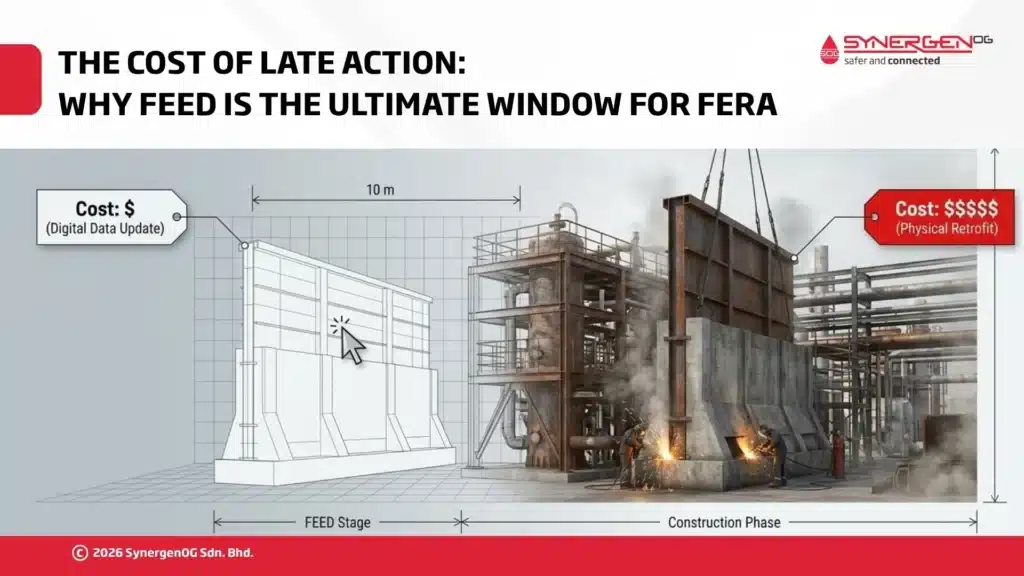
At this stage, the project can still adjust:
- Equipment layout
- Module arrangement
- Separation distances
- Escape routes
- Fire and gas detection philosophy
- Deluge and firewater design
- Blowdown and isolation strategy
- Blast wall requirements
- Temporary refuge design
- Occupied building location and specification
FERA can also be performed later during detailed design, construction, or operations, but late-stage studies may lead to costly redesign if the results show unacceptable fire or explosion risk.
For brownfield facilities, FERA should be considered during management of change, debottlenecking, life extension, capacity increase, or any modification that affects the fire and explosion hazard profile.
Conclusion
A Fire and Explosion Risk Assessment is a core process safety study for oil and gas projects with credible fire and explosion hazards.
FERA is typically required when a project involves pressurized flammable hydrocarbons, gas or vapor release potential, ignition sources, congested layouts, occupied buildings, temporary refuge exposure, or regulatory and client requirements for major accident hazard assessment.
For greenfield projects, FERA helps optimize layout and protection measures before design decisions are locked. For brownfield modifications, it helps confirm whether the existing facility remains safe under changed operating conditions.
The safest and most cost-effective approach is to assess FERA applicability early. If credible fire and explosion scenarios exist, performing FERA at the right stage can improve safety, reduce redesign risk, support regulatory approval, and strengthen overall process safety assurance.
SynergenOG supports facilities in identifying whether a Fire and Explosion Risk Assessment is required by evaluating credible fire, explosion, and loss-of-containment scenarios. Through its technical risk and process safety capabilities, SynergenOG helps clients assess hazards, model consequences, review existing safeguards, and determine whether risks are controlled to acceptable levels. Rather than treating FERA as a compliance exercise, SynergenOG positions it as a practical decision-making tool to improve facility design, asset protection, emergency response, and operational safety. Its expertise enables organisations to identify risk gaps early and implement effective mitigation measures across the asset lifecycle.
Technical Note: This article provides general technical guidance on the FERA Study requirements. These requirements vary by company procedure, process risk, and asset lifecycle stage. This general process safety guidance should be applied alongside applicable regulations, standards, internal engineering practices, and competent professional judgment.
References
- https://www.hse.gov.uk/pubns/books/l65.htm
- https://www.legislation.gov.uk/uksi/1995/743/contents
- https://oeuk.org.uk/product/fire-and-explosion-guidelines-issue-2/
- https://ccps.aiche.org/publications/books/guidelines-fire-protection-chemical-petrochemical-and-hydrocarbon-processing-facilities
- https://www.api.org/
- https://www.questconsult.com/services/siting-studies/api-rp-752/
FERA - FAQs
- What are the main outputs of a FERA study?
Common FERA outputs include fire radiation contours, explosion overpressure results, gas dispersion analysis, escalation assessment, blast load definition, safety-critical equipment survivability review, and recommendations for mitigation.
- Can FERA reduce project cost?
Yes. When conducted early, FERA can reduce project cost by identifying risk-based design improvements before construction. It can help avoid late-stage redesign, unnecessary overprotection, or expensive retrofits.
- What facilities usually require FERA?
FERA is commonly required for offshore platforms, LNG terminals, refineries, gas processing plants, compressor stations, petrochemical units, and other facilities handling pressurized flammable hydrocarbons.
- Is FERA the same as QRA?
No. FERA focuses on fire and explosion consequences, such as thermal radiation and blast overpressure. QRA combines consequence data with event frequency to estimate individual risk, societal risk, and overall risk tolerability.
- Is FERA required for brownfield modifications?
Yes, FERA may be required for brownfield modifications if the change affects hydrocarbon inventory, pressure, operating conditions, layout congestion, equipment spacing, ignition potential, or escalation risk.
- When should a FERA study be conducted?
A FERA study should ideally be conducted during FEED or early detailed design. This allows the findings to influence layout, blast protection, fire protection, escape routes, and occupied building design before major project decisions are finalized.
- Is FERA mandatory for all oil and gas projects?
No. FERA is not automatically mandatory for every oil and gas project. It is typically required or strongly recommended when credible fire and explosion hazards exist, especially where pressurized flammable hydrocarbons, congestion, confinement, occupied buildings, or escalation potential are present.