
| Summary: Hazardous area classification (HAC) identifies locations where flammable gas, vapour, mist, or combustible dust can form an explosive atmosphere. It classifies areas as Zone 0, Zone 1, Zone 2, or dust Zones 20, 21, and 22 based on release likelihood, duration, ventilation and material properties. A defensible HAC study supports Ex equipment selection, ignition source control, inspection planning, management of change and audit-ready hazardous area drawings. Read more about HAC and its impacts here. |
What Is Hazardous Area Classification?
Hazardous area classification, often shortened to HAC, is the engineering process used to identify where an explosive atmosphere could form and how likely it is to be present. In oil and gas facilities, this normally means assessing credible releases of flammable gas, vapour, mist or liquid-produced vapour from process equipment, storage systems, vents, drains, sampling points and utility systems.
The output is not just a drawing. A good HAC package explains the source of release, release grade, substance data, ventilation basis, selected zone type, and zone extent. The resulting hazardous area drawings then guide equipment selection, ignition source control, inspection planning, permit-to-work restrictions, and Management of Change (MOC).
HAC matters because over-classification and under-classification both create problems. Blanket Zone 1 areas can drive unnecessary Ex equipment cost and make operations harder to manage. Under-classification can place ignition-capable equipment too close to credible release sources. The objective is the smallest technically defensible hazardous area, supported by containment, ventilation, and evidence.
What Is a Hazardous Location?
A hazardous location is an area where a flammable or explosive atmosphere can occur in a quantity requiring special precautions. A non-hazardous area is one where an explosive atmosphere is not expected in a quantity requiring those precautions. The boundary between the two must be justified by substance properties, release source assessment, ventilation, congestion, containment and the selected standard.
In practical terms, a hazardous location is not defined by whether flammable material exists anywhere on site. It is defined by whether that material can escape, mix with air within its flammable range, persist long enough to matter and encounter a credible ignition source.
Where Is HAC Performed in Oil and Gas Facilities?
HAC is required or commonly applied across facilities where flammable fluids are produced, processed, stored, transferred or distributed. Typical oil and gas applications include onshore processing plants, offshore platforms, refineries, LNG facilities, gas compression stations, tank farms, terminals, loading racks, fuel depots, petrol stations, chemical injection packages, produced water systems and pipeline stations.
Brownfield sites need special attention because the current plant often differs from the original design package. Added skids, rerouted vents, temporary pumps, blocked louvres, new sample points, and unused but live connections can all change the classification.
HAC Zones – Zone 0, Zone 1, and Zone 2: Gas and Vapour Areas
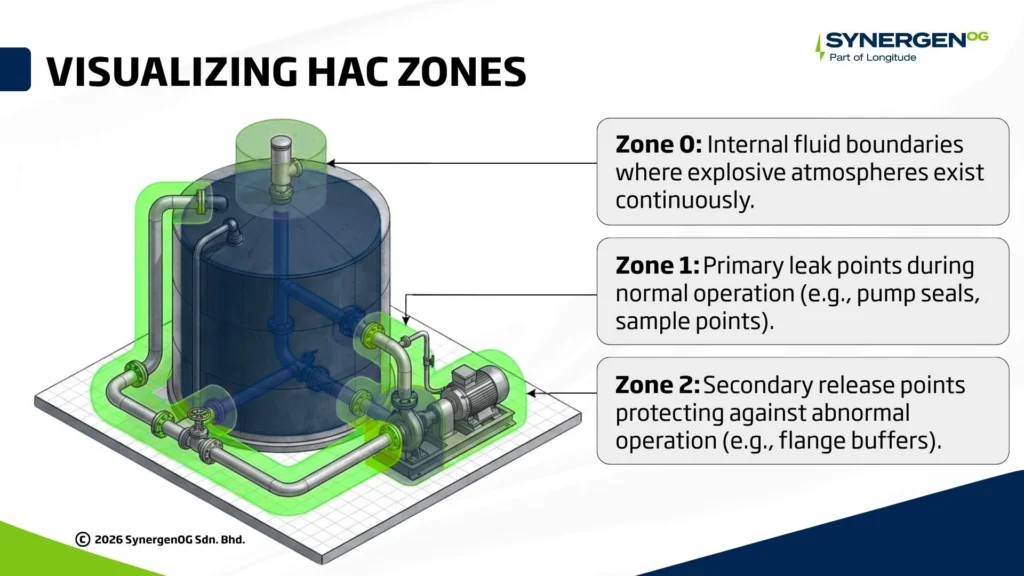
IEC and ATEX-style zone classification for gas and vapour areas is based on the frequency and duration of an explosive atmosphere. The same principle is used in many oil and gas HAC studies, subject to the governing jurisdiction and project basis.
| Area | Meaning | Typical oil and gas examples | Equipment expectation |
| Zone 0 | An explosive atmosphere is present continuously, for long periods or frequently. | Inside tanks, vessels, separators, enclosed process spaces or pipework containing flammable atmosphere. | Category 1G / EPL Ga |
| Zone 1 | An explosive atmosphere is likely to occur in normal operations occasionally. | Pump seals, compressor seals, sample points, open drains, routine vent points, and areas around primary release sources. | Category 2G / EPL Gb or better |
| Zone 2 | An explosive atmosphere is not likely in normal operation, and if it occurs, it exists only for a short time. | Flanges, valve packing, instrument fittings, secondary release points and buffer envelopes around Zone 1 areas. | Category 3G / EPL Gc or better |
| Non-hazardous | An explosive atmosphere is not expected in a quantity requiring special precautions. | Control rooms, offices, and remote open areas are subject to assessment and ventilation assumptions. | Standard equipment may be acceptable if other risks do not apply |
Indicative time bands are often used as engineering guidance: more than 1,000 hours per year for Zone 0, 10 to 1,000 hours per year for Zone 1, and less than 10 hours per year for Zone 2. Treat these as guidance, not automatic legal definitions. The classification should remain grounded in release likelihood, duration, ventilation, and the selected standard.
Dust Zones 20, 21, and 22: When They Matter
Oil and gas HAC studies usually focus on gases and vapours. Still, combustible dusts, fibres, and flyings can matter in adjacent or integrated facilities such as sulphur handling, catalyst handling, carbon black, polymers, grain-based biofuel blending, powders, additives, and packaging areas. Dust zones use a parallel classification logic.
| Dust zone | Meaning | Typical examples |
| Zone 20 | An explosive dust cloud is present continuously, for long periods or frequently. | Inside dust collectors, silos, enclosed conveyors, and process equipment handling combustible powders. |
| Zone 21 | An explosive dust cloud is likely to occur in normal operation occasionally. | Bagging points, transfer points, open charging points, and areas near routine dust release sources. |
| Zone 22 | An explosive dust cloud is not likely in normal operation, and if it occurs, it persists only for a short time. | Areas around equipment where dust release is abnormal but credible, subject to housekeeping and ventilation. |
Dust classification should not be forced into a gas-only HAC basis. Use the applicable dust standard and consider dust layers, housekeeping, re-entrainment, hybrid mixtures, and ignition characteristics such as minimum ignition temperature and minimum ignition energy.
Class/Division vs Zone: Which System Should Be Used?
Two classification systems are common. The zone system uses Zone 0, Zone 1, and Zone 2 for gases and Zone 20, Zone 21, and Zone 22 for dusts.
The North American division system classifies hazardous locations by Class, Division, and Group. For example, Class I applies to gases and vapours, Class II to combustible dusts, and Class III to fibres/flyings; Division 1 is normally more frequent or likely presence, while Division 2 is normally abnormal or short-duration presence.
The correct system depends on jurisdiction, owner standards, client requirements, and the project basis. Avoid mixing API RP 500, API RP 505, IEC 60079-10-1, IEC 60079-10-2, EI 15, NFPA 497 and NFPA 499 without a written basis of classification. If a site has legacy division drawings and a new project uses zones, define the interface clearly before procurement and construction.
Common Standards and Guidance for HAC
| Reference | What it covers | Common use |
| IEC 60079-10-1 | Classification of areas where flammable gas or vapour hazards may arise. | Gas and vapour hazardous area classification. |
| IEC 60079-10-2 | Identification and classification of areas where explosive dust atmospheres and combustible dust layers are present. | Combustible dust classification. |
| ATEX Workplace Directive 1999/92/EC | Employer duties for explosive atmospheres, including zone classification and explosion protection documentation in EU regimes. | EU/ATEX-aligned workplaces. |
| EI 15 | Area classification code for installations handling flammable fluids, including equipment handling or storing flammable fluids. | Oil, gas, refining, fuel distribution and flammable fluid installations. |
| API RP 505 | Zone classification for petroleum facilities is classified as Zone 0, Zone 1, and Zone 2. | Petroleum facilities using the zone system. |
| API RP 500 | Division classification for petroleum facilities is classified as Class I, Division 1 and Division 2. | Petroleum facilities using the division system. |
| NFPA 497 | Recommended practice for flammable liquids, gases or vapours in chemical process areas. | North American Class I classification support. |
| NFPA 499 | Recommended practice for combustible dusts and hazardous locations for electrical installations. | North American combustible dust classification support. |
| ISO/IEC 80079-36 and 80079-37 | Non-electrical equipment and ignition risk requirements for explosive atmospheres. | Mechanical equipment and non-electrical ignition source control. |
How to Do Hazardous Area Classification: The Methodology
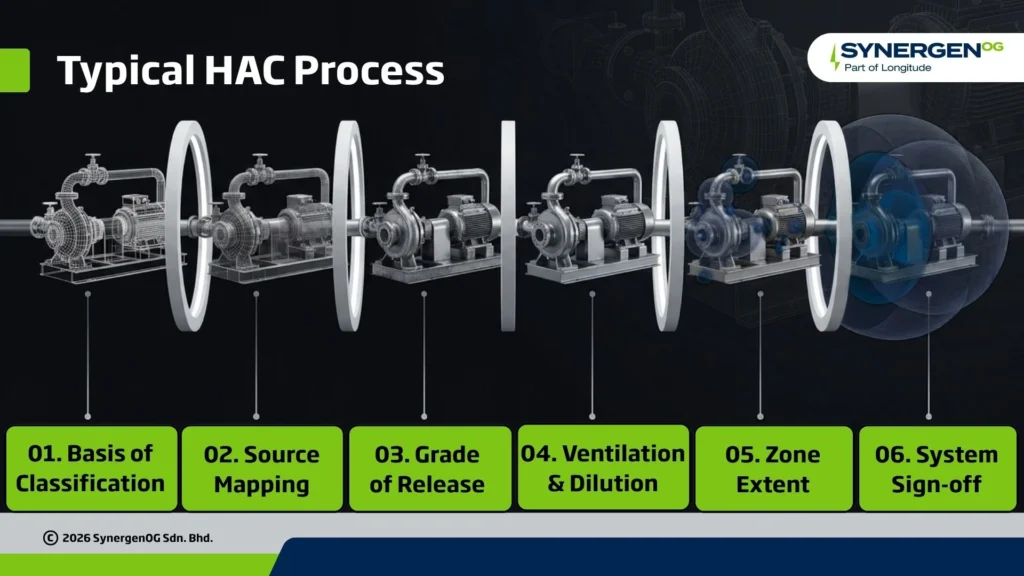
A defensible HAC study should be a documented assessment, not a drawing exercise. The sequence below works for new designs and brownfield updates.
| Step | What the team does | Output |
| Define the basis | Set scope, jurisdiction, standard, edition, substances, assumptions, operating cases, and drawing conventions. | HAC philosophy or basis document |
| Collect data | Review PFDs, P&IDs, plot plans, equipment datasheets, relief and vent data, drainage layout, operating conditions, MSDS/SDS, and substance properties. | Data register and document list |
| Identify release sources | Identify credible continuous, primary, and secondary release sources from equipment, connections, vents, drains, seals, and operating tasks. | Source of the release register |
| Assign release grade | Determine whether each source is continuous, primary, or secondary based on expected occurrence during normal operation. | Release grade schedule |
| Assess ventilation and dilution | Evaluate natural or mechanical ventilation, availability, dilution effectiveness, enclosure effects, and failure response. | Ventilation assumptions and notes |
| Determine zone type and extent | Apply the selected standard or project method to assign the zone and radius/envelope for each source. | Zone schedule and calculations |
| Prepare drawings | Show zones in plan and, where required, elevation views around vents, pipe racks, bunds, modules, and enclosed packages. | Hazardous area drawings |
| Review and approve | Review with process, electrical, instrumentation, safety, operations, and maintenance representatives. | Approved HAC package and action register |
Factors That Affect Zone Extent
Zone extent is sensitive to process and layout details. The most important factors are:
- Material properties: Flash point, boiling point, vapour pressure, LEL/UEL, ignition temperature, gas group, temperature class, and vapour density.
- Release characteristics: Hole size, pressure, temperature, phase, release direction, release duration, and whether the source is continuous, primary, or secondary.
- Ventilation and dilution: Outdoor openness, enclosure geometry, mechanical ventilation rate, reliability, alarms, and fallback response on fan failure.
- Containment and drainage: Bunds, sumps, open drains, trenches, and low points where heavier-than-air vapours may accumulate.
- Congestion and confinement: Modules, shelters, walls, weather protection, cable trenches, and equipment congestion that can restrict dispersion.
- Operating mode: Startup, shutdown, sampling, loading, maintenance, purging, depressurisation, and temporary equipment use.
- Safeguards and management controls: Leak detection, isolation, operating procedures, inspection, maintenance, and permit-to-work controls.
What a Good HAC Deliverable Should Include
A useful HAC package must be easy for engineers, operators, maintainers, and auditors to understand. At a minimum, it should include:
- Basis of classification, including governing standard, edition, assumptions, and exclusions.
- Substance data table with flammable properties, gas group, temperature class, and relevant operating conditions.
- Source of release register showing each release point, grade, fluid, phase, pressure, temperature, ventilation basis, and zone extent.
- Ventilation assessment notes, including natural ventilation assumptions and mechanical ventilation availability where relevant.
- Hazardous area drawings with scaled plan views and elevation views where required.
- Zone schedule and calculation notes for traceability.
- Equipment selection recommendations linked to zone, gas group, temperature class, EPL/category, IP rating, and certificate conditions.
- Brownfield gap assessment for field changes, blocked ventilation, undocumented drains, added skids, and temporary equipment.
- Revision history, action register, and links to Ex register, inspection plans, PSSR, MOC, and permit-to-work procedures.
HAC vs HAZOP vs Fire and Gas Mapping
HAC, HAZOP and Fire and Gas Mapping are complementary studies, but they answer different questions. Confusing them creates gaps in process safety assurance.
| Study | Main question | Typical output |
| HAC | Where can explosive atmospheres occur, and what equipment/ignition controls are required? | Hazardous area drawings, source register, zone schedule, and Ex equipment basis. |
| HAZOP | What process deviations can occur, what causes them, and what safeguards are needed? | HAZOP report, causes, consequences, safeguards and actions. |
| Fire and Gas Mapping | Where should detectors be located to achieve the required coverage? | Detector coverage maps, performance targets, and detector placement recommendations. |
9 Costly HAC Mistakes and How to Fix Them
Mistake 1: Blanket Zone 1 for the whole unit
Classifying an entire process unit as Zone 1 may look cautious, but it often hides weak engineering, increases equipment costs, and makes the drawing less useful. Fix it by assessing each source separately, applying the selected standard consistently, and documenting why each boundary exists.
Mistake 2: Treating HAC as electrical-only
Electrical equipment matters, but ignition risk also includes hot surfaces, static electricity, mechanical sparks, friction, vehicles, mobile equipment, and non-electrical rotating equipment. Fix it by linking HAC to ignition source control, Ex inspection, permits and the ISO/IEC 80079 non-electrical equipment framework.
Mistake 3: Using the wrong standard or edition
International projects become inconsistent when standards are mixed without a clear basis. Fix it by defining the governing standard, edition and jurisdiction before calculations start, and by documenting how legacy division drawings interface with new zone drawings.
Mistake 4: Weak ventilation assumptions
Ventilation can change zone type and extent. A partly enclosed structure, a blocked louvre or a failed fan can invalidate a classification. Fix it by recording all ventilation assumptions and defining alarms, failure response, and fallback classification when mechanical ventilation is credited.
Mistake 5: No HAC review after modification
New skids, sample points, drains, vents, enclosures, and process fluids can create new release sources or change dispersion. Fix it by adding a mandatory MOC question: Does this change affect release sources, ventilation, hazardous area classification or Ex equipment?
Mistake 6: Wrong Ex equipment selection
A correct zone does not guarantee a correct installation. The item must also match gas group, temperature class, EPL/category, ambient range, IP rating, and certificate conditions. Fix it by maintaining an Ex equipment register and verifying certificates before procurement, installation and PSSR.
Mistake 7: Ignoring mists, dusts, or hybrid mixtures
Gas-only classification can miss pressurised flammable mists, combustible dust layers, fibres/flyings or hybrid mixtures. Fix it by checking the actual materials and operating conditions, then applying the appropriate gas, mist or dust classification method.
Mistake 8: No field validation on brownfield assets
Desktop updates can miss real site conditions such as blocked ventilation, relocated equipment, capped-but-live branches, temporary pumps, and undocumented vents. Fix it by combining drawing review with structured field verification and photographs.
Mistake 9: Treating HAC as a one-time deliverable
A HAC package can be correct at handover and wrong several years later. Fix it by assigning an owner, linking HAC to MOC and incident learning, and scheduling periodic health checks according to risk, modification rate, and company or regulatory expectations.
Implementation Checklist for Facility Owners
- Confirm that the HAC basis document names the governing standard, edition, jurisdiction, and assumptions.
- Check that every zone shown on the drawing traces back to a release source in the register.
- Verify that ventilation assumptions match current field conditions.
- Confirm Ex equipment selection against zone, gas group, temperature class, EPL/category, and certificate conditions.
- Review brownfield changes, temporary equipment, and MOC records against the current HAC drawings.
- Link the latest HAC package to the Ex register, inspection plan, permit-to-work system, and PSSR checklist.
- Rain operations and maintenance teams on what the drawings mean and when to request a HAC review.
SynergenOG helps oil and gas and other energy facilities produce HAC studies that are clear, technically defensible, and practical for daily use. Our services include new facility HAC studies, operating plant gap assessments, hazardous area drawing reviews after modifications, Ex equipment register checks, and process safety integration with HAZOP, PSM, MOC, and PSSR systems.
References
- https://webstore.iec.ch/en/publication/63327
- https://webstore.iec.ch/en/publication/623
- https://www.hse.gov.uk/comah/sragtech/techmeasareaclas.htm
- https://www.energyinst.org/industry/publications/topics/asset-integrity/ei-model-code-of-safe-practice-part-15-area-classification-for-installations-handling-flammable-fluids
- https://www.api.org/products-and-services/standards/important-standards-announcements/rp500article
- https://www.nfpa.org/codes-and-standards/nfpa-497-standard-development/497
- https://www.nfpa.org/codes-and-standards/nfpa-499-standard-development/499
Technical Note: This article provides general technical guidance on hazardous area classification in oil and gas facilities. Classification requirements may vary depending on the applicable code or standard, process conditions, hazardous substances, equipment design, facility layout, operating philosophy, and project lifecycle stage. This guidance should be applied alongside relevant regulations, industry standards, company engineering practices, site-specific risk assessments, and the judgment of competent hazardous-area professionals.
Hazardous Area Classification - FAQs
- How is HAC different from HAZOP?
HAC identifies where explosive atmospheres may occur and supports equipment/ignition control decisions. HAZOP studies process deviations, causes, consequences and safeguards. They should inform each other, but one does not replace the other.
- How often should HAC drawings be reviewed?
Review HAC drawings whenever modifications affect release sources, ventilation, substances, layout, equipment location or operating conditions. A periodic health check is also good practice for operating facilities, especially where brownfield modifications are frequent.
- Can Zone 2 equipment be used in Zone 1?
No. Equipment suitable only for Zone 2 is not suitable for Zone 1 unless its certification also covers Zone 1 requirements. Always verify the equipment category or EPL, gas group, temperature class and certificate conditions.
- Who owns hazardous area classification?
The facility owner or operator remains accountable for safe operation and should own the HAC package. A consultant can prepare the study, but the asset owner should control updates, implementation and links to MOC, PSSR, inspection and permit-to-work systems.
- What documents are needed for a HAC study?
Typical inputs include PFDs, P&IDs, plot plans, equipment datasheets, relief and vent information, drainage drawings, operating conditions, SDS/MSDS data, substance properties, equipment layouts and existing hazardous area drawings for brownfield sites.
- When should a HAC study be performed?
Perform HAC during concept or detailed design before equipment selection, and review it whenever process conditions, substances, release sources, ventilation, layout, equipment location or operating mode changes.
- Which standard should be used for HAC?
The standard depends on jurisdiction, client requirements and project basis. Common references include IEC 60079-10-1 for gas and vapour, IEC 60079-10-2 for dust, EI 15 for installations handling flammable fluids, API RP 505 for petroleum facilities using zones and API RP 500 for petroleum facilities using divisions.
- What are Zone 20, Zone 21 and Zone 22?
Zone 20, Zone 21 and Zone 22 are dust zones. Zone 20 is continuous or frequent dust cloud presence, Zone 21 is likely occasional dust cloud presence during normal operation, and Zone 22 is unlikely or short-duration dust cloud presence.
- What are Zone 0, Zone 1 and Zone 2?
Zone 0 means an explosive atmosphere is present continuously, frequently or for long periods. Zone 1 means it is likely to occur in normal operation occasionally. Zone 2 means it is not likely in normal operation and, if it occurs, will exist only for a short time.
- What is hazardous area classification in oil and gas?
Hazardous area classification is the process of identifying locations where flammable gas, vapour, mist or combustible dust could create an explosive atmosphere. It assigns zones based on release likelihood, duration, material properties, ventilation and dilution so the facility can select suitable equipment and control ignition sources.