
| Summary: What are the typical flaws in a HAZOP process? Why does a HAZOP study/workshop fail to fulfill its targeted aim? This article serves as a guide for engineering and safety professionals to restore the technical integrity of their process safety reviews by crossectioning the root causes of HAZOP failures. |
Hazard and Operability Study (HAZOP) is one of the most widely used structured techniques for identifying process hazards and operability problems across the process industries.
When conducted properly, a HAZOP study helps engineering, operations, maintenance, controls, and safety teams systematically examine how a process could deviate from its intended design — and whether existing safeguards are adequate.
Yet many project managers, engineering leads, and HSE professionals have seen HAZOP effectiveness erode into a compliance exercise. The team spends days working through guide words, a report is issued, actions are logged, and the study quietly loses influence over the project.
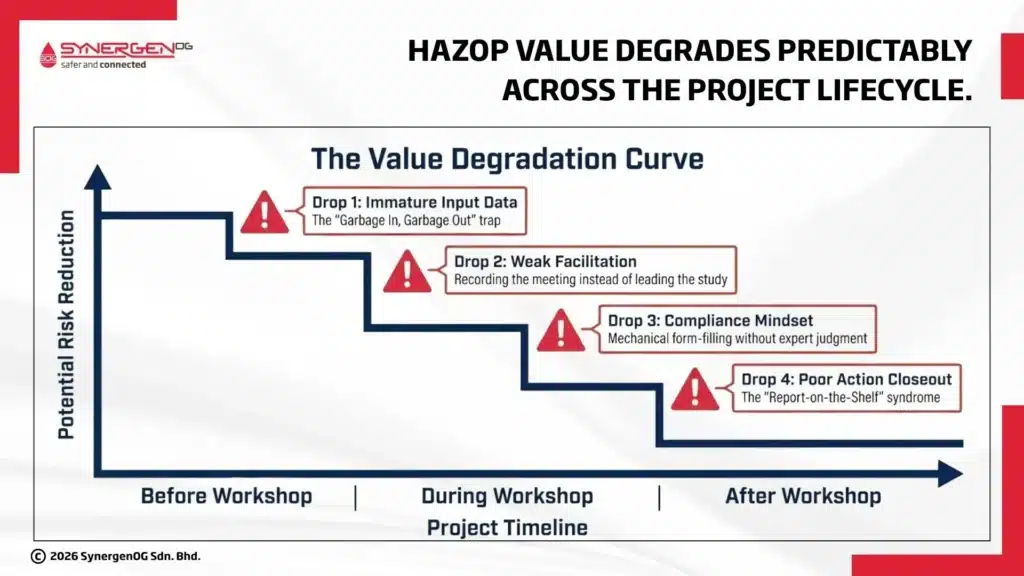
The most common reasons HAZOP studies lose effectiveness are poor preparation, weak facilitation, a compliance-only mindset, and failure to close recommendations. The methodology itself rarely fails. Execution does.
This article explains four common root causes of poor HAZOP performance and how to prevent them before they undermine the value of your next process safety review.
Key Takeaways
HAZOP studies usually lose effectiveness for four predictable reasons:
- The design or operating information is not mature enough for the study.
- The facilitator records the meeting but does not actively lead the HAZOP process.
- The organization treats the workshop as a compliance requirement rather than a risk-reduction activity.
- Recommendations are recorded but not implemented, verified, or carried into the next project or asset lifecycle stage.
Improving HAZOP quality requires a formal readiness gate, competent facilitation, risk-focused discussion, and verified recommendation closure.
What Is HAZOP Effectiveness?
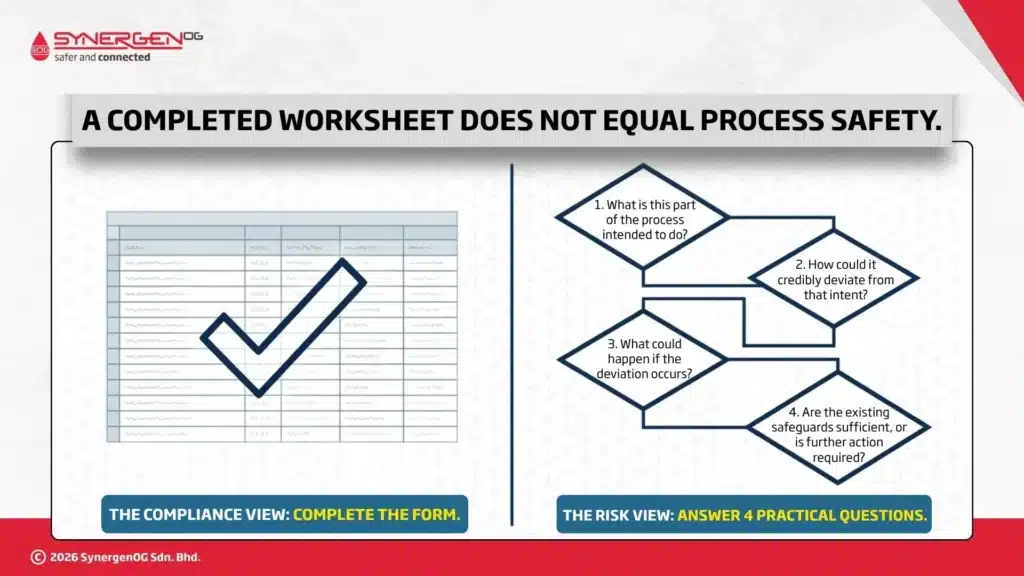
HAZOP effectiveness is the degree to which a HAZOP study identifies credible deviations, evaluates consequences and safeguards accurately, generates useful recommendations, and leads to verified risk reduction.
A HAZOP is not effective simply because the worksheet is complete. It is effective when it improves process safety decisions.
A high-quality HAZOP should answer four practical questions:
- What is this part of the process intended to do?
- How could it credibly deviate from that intent?
- What could happen if the deviation occurs?
- Are the existing safeguards sufficient, or is further action required?
The HAZOP method provides structure through nodes, guide words, process parameters, deviations, causes, consequences, safeguards, and recommendations. However, that structure only creates value when the team applies sound engineering judgment.
Read: HAZID vs HAZOP – When Do You Choose One
HAZOP Failure Modes at a Glance
| HAZOP failure mode | Primary cause | Risk created | Prevention |
| Poor hazard identification | Immature or inaccurate input information | Credible scenarios may be missed | Establish a formal HAZOP readiness gate |
| Shallow workshop discussion | Weak facilitation | Groupthink, rushed decisions, or weak safeguards may go unchallenged | Appoint a competent HAZOP facilitator |
| Low participant engagement | Compliance-only mindset | The study becomes a form-filling exercise | Reframe the workshop around risk quality |
| No verified risk reduction | Poor action closeout | Recommendations remain unresolved or ineffective | Track actions through to verified closure |
Root Cause 1: The “Garbage In, Garbage Out” Preparation Trap
The most common HAZOP mistake is inadequate preparation.
A HAZOP study is only as reliable as the information placed in front of the team. If P&IDs, PFDs, cause-and-effect diagrams, control narratives, relief design data, operating procedures, or vendor package details are incomplete or inconsistent, the workshop quickly becomes a debate about documentation rather than a structured analysis of process hazards.
For new projects, this does not mean that every drawing must be “as-built” before a HAZOP can begin. HAZOP studies are frequently performed during design, before construction. The real requirement is that design information must be sufficiently mature, checked, and controlled for the study.
For existing facilities, the requirement is different. Documents used in the HAZOP must accurately reflect the as-built condition of the plant.
When the team spends a significant portion of the session questioning whether drawings are correct, they lose the focus required for meaningful hazard identification. Ambiguous design intent, unresolved vendor interfaces, and undocumented assumptions all reduce HAZOP quality and increase the risk of missed hazards.
How to Improve HAZOP Preparation
Establish a formal HAZOP readiness gate before the workshop begins.
At a minimum, confirm that:
- The design intent is clear for each system, node, or operating mode.
- P&IDs and PFDs are at the correct maturity level for the study stage.
- Key vendor package information and interface assumptions are available.
- Cause-and-effect diagrams, control narratives, and safeguarding information are aligned.
- Relief and venting basis information is sufficiently developed for the scope being reviewed.
- Unresolved assumptions are logged, owned, and tracked for later validation.
- For existing assets, drawings and procedures have been verified against the as-built facility.
Where appropriate, a prior HAZID, design review, or constructability review can also help remove obvious high-level issues before the detailed HAZOP begins.
A HAZOP is not a substitute for sound design practice, applicable codes and standards, or other hazard identification methods. It is a structured review that tests the design against credible deviations from intended operation. The better the design basis, the more valuable the HAZOP becomes.
Root Cause 2: The Facilitation Gap — Recording the Meeting Is Not Leading the Study
One of the most underappreciated HAZOP pitfalls is the role of the facilitator.
A common HAZOP mistake is treating the facilitator as a meeting administrator or scribe. Recording the discussion is important, but it is not the same as leading the study.
A HAZOP facilitator is not merely a recorder. The facilitator protects the methodology, challenges weak assumptions, controls workshop pace, manages team dynamics, and ensures that recommendations are specific and auditable.
An ineffective facilitator may allow dominant personalities to close down legitimate concerns, let the team rush through complex nodes, accept weak safeguards without challenge, or spend too much time on low-consequence operability issues. At the same time, major accident hazards receive insufficient attention.
These are hallmarks of a low-quality HAZOP outcome.
The facilitator does not need to be the only technical authority in the room. Technical authority should come from the collective expertise of the team, including process engineering, operations, maintenance, instrumentation, controls, safety, and project engineering.
However, the facilitator must be competent enough to challenge unsupported assumptions, recognize when the team is drifting, and bring the discussion back to credible deviations, consequences, safeguards, and actions.
HAZOP Best Practices for Facilitation
Appoint a competent HAZOP facilitator, not just a meeting recorder.
A high-quality HAZOP facilitator should be able to:
- Maintain the discipline of the HAZOP methodology.
- Keep the team focused on design intent and credible deviations.
- Challenge assumptions without becoming adversarial.
- Distinguish between minor operability concerns and major accident hazards.
- Prevent groupthink and dominance by a single discipline or stakeholder.
- Manage workshop pace without rushing high-risk discussions.
- Ensure recommendations are specific, assignable, and auditable.
Independent facilitation can be valuable, especially for high-risk processes, politically sensitive projects, or studies where project bias may be a concern.
However, independence alone is not sufficient. Competence, process safety judgment, and command of the HAZOP method are what matter most in driving HAZOP quality improvement.
Root Cause 3: The Compliance-Only Mindset — When HAZOP Becomes a Form-Filling Exercise
HAZOPs often lose effectiveness when the organization treats the study primarily as a regulatory, insurance, or project-stage gate requirement.
When the goal is simply to “get the HAZOP done,” the workshop becomes a documentation exercise rather than a critical engineering intervention. Teams may focus on closing worksheets quickly, minimizing recommendations, or avoiding issues that could affect cost or schedule.
The result is a false sense of assurance: the project has a HAZOP report, but the process hazard review has not delivered meaningful risk reduction.
A compliance mindset also encourages mechanical use of guide words. Guide words are essential to the HAZOP method, but they are not a substitute for thinking.
If the team applies every guide word to every node without judgment, the study becomes repetitive, dull, and inefficient. Participants disengage, and the workshop loses the creative challenge that underpins effective HAZOP studies in the process industries.
The goal is not merely to complete the HAZOP table. The goal is to understand how deviations from design intent could create hazardous or operability consequences, whether existing safeguards are adequate, and what must be done where they are not.
Reframing the HAZOP Around Risk Quality
Before the workshop begins, align the team on three questions:
- What is this part of the process intended to do?
- How could it credibly deviate from that intent?
- Are the existing safeguards sufficient for the consequences?
Guide words should support this thinking, not replace it.
If a guide word is not meaningful for a specific node, the facilitator should document that judgment and move on. If a deviation is credible and potentially serious, the team must slow down and examine it properly.
The best HAZOP studies are disciplined, not mechanical. They use structure to support expert judgment, not to replace it. This is the defining difference between a HAZOP that adds genuine safety value and one that simply fulfils a process hazard analysis requirement.
Root Cause 4: The “Report-on-the-Shelf” Syndrome
The most serious HAZOP failure often occurs after the workshop ends.
A technically strong HAZOP still fails if its recommendations are not implemented, verified, and carried into the next stage of the asset lifecycle.
Too often, actions are recorded in the report, assigned during the closeout meeting, and then allowed to drift. By commissioning or startup, unresolved recommendations may be treated as administrative paperwork rather than risk controls.
A HAZOP is not complete when the report is issued. It is complete when recommendations are assigned, tracked, implemented, and verified.
Poor HAZOP action management creates several compounding problems:
- Actions assigned without clear accountability become effectively unowned.
- Recommendations written in vague language are difficult to close and verify.
- Design actions may be closed administratively without confirming that the intended risk reduction was achieved.
- Safety-critical recommendations may be rushed during late-stage commissioning, when cost and schedule pressure are highest.
- Lessons from the HAZOP may fail to reach operating procedures, maintenance plans, SIS lifecycle documentation, or training materials.
A HAZOP report is not the end product. Risk reduction is the end product.
Building Action Management Into the HAZOP Process
Every HAZOP recommendation should include:
- A clear, specific action statement.
- A responsible owner, whether a named individual or a clearly accountable role supported by the action-tracking system.
- A due date aligned with the project schedule or operating risk profile.
- A defined closure requirement.
- A verification method.
- A record of final resolution.
HAZOP actions should be integrated into the appropriate controlled management system. Depending on the facility and project stage, this may include:
- The project action tracker.
- The Management of Change process.
- The Pre-Startup Safety Review tracker.
- The engineering change register.
- The computerized maintenance management system.
- SIS lifecycle documentation.
- Operating procedure updates.
- Training and competency records.
What matters is that recommendations are visible, owned, tracked, and verified before the relevant risk is introduced.
A HAZOP study should not be considered complete simply because the workshop has ended or the report has been issued. It is complete only when its actions have been properly resolved, and the risk has genuinely been reduced.
How to Improve HAZOP Effectiveness
Improving HAZOP effectiveness requires attention before, during, and after the workshop.
Before the HAZOP, confirm that design information is mature enough, the study scope is clear, the right disciplines are available, and unresolved assumptions are visible.
During the HAZOP, maintain method discipline, focus on credible deviations, challenge weak safeguards, and ensure that significant hazards receive the attention they deserve.
After the HAZOP, manage recommendations as safety-critical outputs. Assign owners, define closure criteria, verify implementation, and carry relevant outcomes into commissioning, operations, maintenance, and process safety management systems.
The most effective HAZOP studies are not the ones that generate the longest worksheets. They are the ones that help teams make better risk decisions.
Conclusion: Making HAZOP Studies Worth the Effort
A HAZOP is not just a meeting. It is a structured engineering review designed to test whether a process can safely tolerate credible deviations from its intended design.
When applied correctly, HAZOP remains one of the foremost hazard identification tools in process safety management.
When HAZOP effectiveness fails, the root causes are almost always predictable:
- The input information was not ready.
- The facilitator managed the meeting but did not lead the study.
- The organization treated the exercise as compliance paperwork rather than a critical engineering intervention.
- The recommendations were not tracked through to verified closure.
The solution is equally clear: prepare the study properly, appoint a competent facilitator, focus the team on design intent and credible risk, and manage recommendations as safety-critical project outputs.
When done well, a HAZOP remains one of the most powerful tools for identifying process hazards before they become incidents, and one of the most cost-effective investments a high-hazard project can make.
HAZOP Failures Frequently Asked Questions
- Why is independent HAZOP facilitation useful?
Independent facilitation can reduce project bias and help challenge assumptions more freely. However, competence matters more than independence alone. The facilitator must understand process safety principles and the HAZOP method well enough to lead a disciplined and useful review.
- What makes a good HAZOP facilitator?
A good HAZOP facilitator understands the methodology, manages team dynamics, maintains guide-word discipline, challenges unsupported assumptions, distinguishes major hazards from minor operability issues, and ensures recommendations are clear, assignable, and auditable.
- What documents are required before a HAZOP?
Typical HAZOP input documents include P&IDs, PFDs, design basis documents, cause-and-effect diagrams, control narratives, equipment data, relief and venting information, operating procedures, safeguarding information, and vendor package details. The exact requirements depend on the project stage, process complexity, and study scope.
- Who should attend a HAZOP workshop?
A HAZOP workshop should include the disciplines needed to understand the process, controls, operations, maintenance, safeguards, and project constraints. Typical participants include process engineering, operations, maintenance, instrumentation and controls, process safety, project engineering, and the HAZOP facilitator.
- What makes a HAZOP recommendation effective?
An effective HAZOP recommendation is specific, assignable, risk-based, and verifiable. It should clearly state what needs to be done, who owns the action, when it must be completed, and how closure will be verified.
- How long should a HAZOP session last?
Many organizations limit intensive HAZOP work to half-day sessions or roughly six hours of effective workshop time per day, with regular breaks. The appropriate duration depends on process complexity, team fatigue, preparation quality, and the consequence of missing credible scenarios.
- What is the difference between HAZOP and PHA?
Process Hazard Analysis, or PHA, is a broader term for structured hazard evaluation methods. HAZOP is one type of PHA method. Other PHA methods may include What-If analysis, checklist analysis, FMEA, LOPA, or other risk-review techniques depending on the facility and regulatory context.
- What is the difference between HAZID and HAZOP?
HAZID is a broader, earlier-stage hazard identification exercise. HAZOP is a more detailed, systematic deviation study based on design intent, guide words, process parameters, consequences, safeguards, and recommendations.
- Why is independent HAZOP facilitation useful?
- What makes a good HAZOP facilitator?
A good HAZOP facilitator understands the methodology, manages team dynamics, maintains guide-word discipline, challenges unsupported assumptions, distinguishes major hazards from minor operability issues, and ensures recommendations are clear, assignable, and auditable.
- Who should attend a HAZOP workshop?
A HAZOP workshop should include the disciplines needed to understand the process, controls, operations, maintenance, safeguards, and project constraints. Typical participants include process engineering, operations, maintenance, instrumentation and controls, process safety, project engineering, and the HAZOP facilitator.
- What documents are required before a HAZOP?
Typical HAZOP input documents include P&IDs, PFDs, design basis documents, cause-and-effect diagrams, control narratives, equipment data, relief and venting information, operating procedures, safeguarding information, and vendor package details. The exact requirements depend on the project stage, process complexity, and study scope.
- Do P&IDs need to be as-built before a HAZOP?
Not always. For new projects, P&IDs should be mature, checked, and controlled for the study stage. For existing facilities, documents used in the HAZOP must accurately reflect the as-built condition.
- What is the most common root cause of HAZOP failure?
The most common root cause of HAZOP failure is poor preparation. If design intent, drawings, procedures, vendor information, or safeguarding data are incomplete or inconsistent, the team cannot conduct a reliable analysis. HAZOP effectiveness begins long before the workshop starts.
Technical Note: This article provides general technical guidance on failures in HAZOP studies and their root causes. Requirements for HAZOP studies vary by company procedure, process risk, and asset lifecycle stage. This general process safety guidance should be applied alongside applicable regulations, standards, internal engineering practices, and competent professional judgment.