Summary: This article explains how Quantitative Risk Assessment (QRA) serves different stakeholders—not just as a compliance tool, but as a practical decision engine. It shows how to tailor QRA outputs for executives, project teams, PSM and operations, regulators, insurers, emergency planners, investors, and communities using tools like IR contours, F-N curves, and more. Quantitative Risk...Continue Reading
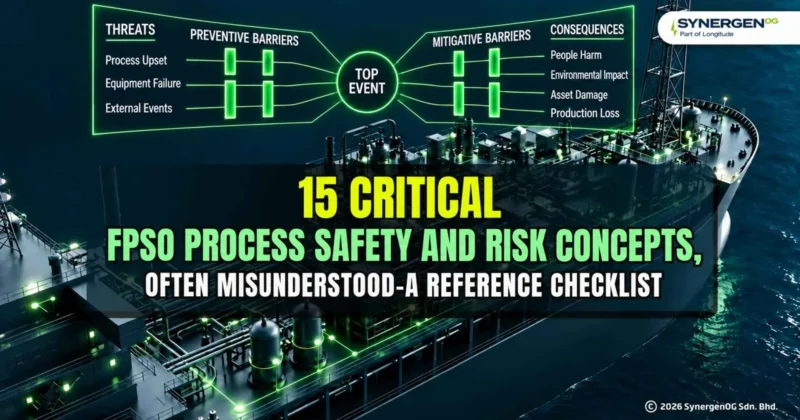
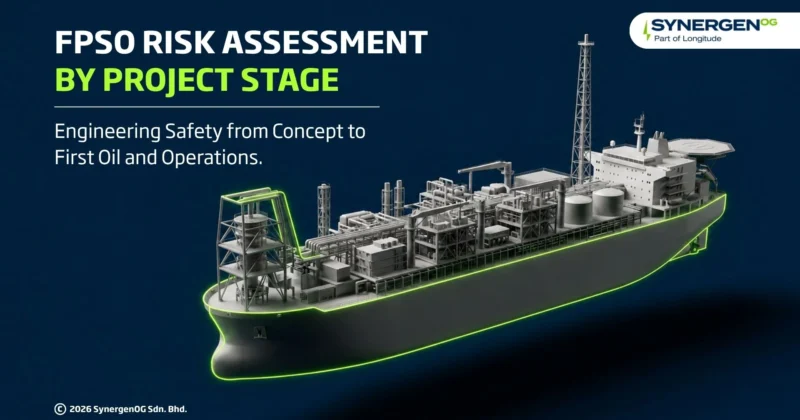
Summary: This article breaks down how to make FPSOs safer by treating process, marine, and storage/offloading risks as one system. Starting from MAHs and bow-ties, we show how to set SCEs that cover cargo tanks and inerting, turret/moorings, risers, DP/drive-off, and shuttle-tanker SIMOPS. We outline practical MOC/SIMOPS controls, proof of barrier health via testing,...Continue Reading
Summary: Quantitative Risk Assessment (QRA) is a structured, data-driven method that estimates how often hazardous events could happen and how severe their consequences could be. By combining frequency analysis with consequence modeling, QRA quantifies individual and societal risk to guide ALARP decisions, safeguard design, emergency planning, and regulatory compliance. Table of Contents Toggle What Is...Continue Reading
Summary: Some of the recent oil, gas, LNG, and chemical incidents highlight how weak hazard identification can escalate into major losses. Investigations reveal recurring gaps: underestimated process deviations, overlooked human–machine interactions, and poor recognition of cascading failures. Missed barriers—such as inadequate relief systems, flawed alarm management, and incomplete safeguards—left operations vulnerable. Root causes often trace...Continue Reading
Summary: Before risks become realities, they exist as overlooked details in design and operation. A Hazard Identification (HAZID) study is not just a checklist—it’s a focused inquiry into how things might go wrong and what that truly means. This blog breaks down the HAZID process into its core mechanics: from defining intent and applying ISO...Continue Reading
Summary: By capturing CO₂ from industrial processes and utilizing, CCUS offers a practical path to deep decarbonization. But as deployment expands, safety and transparency must remain top priorities. This article explores how CCUS is transforming heavy industry while emphasizing the critical need for rigorous oversight and public trust to ensure lasting, responsible progress. Heavy industries—such...Continue Reading